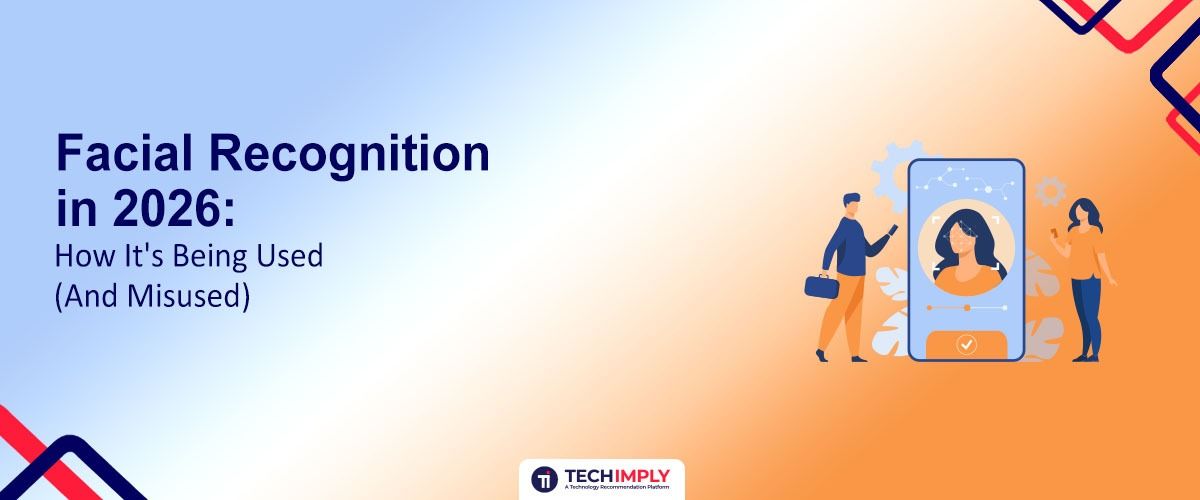
The methods that people use to prove their identity are changing. In previous years, the use of a face to unlock a smartphone was a small tool. At present, it is common to look into a camera when a person walks through an airport in India, opens an account at a bank, or arrives at a place of employment. Facial recognition is no longer a concept from fiction because it is now a part of the systems for daily administration. As this technology becomes a part of regular activities, it creates a clear difference in perspective.

Looking for Facial Recognition Software?
Check out Techimply's List of the Best Facial Recognition Software in India for your business.
For companies and agencies of the government, the technology is fast, it keeps assets safe, and it makes work processes efficient—but for members of the public and those who protect privacy, the technology causes people to ask many questions about how authorities monitor others, how individuals give permission, and how the Digital Personal Data Protection (DPDP) Act keeps data secure. To understand this change, it is necessary to look at the areas where the software works well, the areas where the software fails, and the effect it has on the records of digital activity.
From Airports to National IDs: Where Facial Recognition Is Being Used in India
India is now a place where the use of biometric authentication is increasing at a high rate. The technology is not restricted to laboratories for high-security research. It is active on regular smartphones, on tablet computers at locations where people pay for goods, and on cameras that are located on the street.
1. Identity Verification in Banking and Fintech
The financial sector has heavily adopted facial recognition software to replace legacy, slow paperwork systems.
- Contactless Onboarding: Opening a digital bank account or a demat share-trading profile now takes minutes instead of days. Platforms use video-based Know Your Customer (vKYC) protocols to match a customer’s live video face print against their official government database records.
- Liveness Detection: To prevent bad actors from holding up a static printed photo or a smartphone video screen to the camera, modern verification tools deploy micro-expression scanning. They require you to blink, smile, or turn your head to confirm physical presence.
2. Airport Travel and Public Transportation
The DigiYatra platform framework acts as the primary announced implementation of this system, which has transformed traveler transit at key airports serving Delhi, Mumbai, Bengaluru, and Hyderabad.
- Face as Boarding Pass: The platform employs a 1:1 biometric matching system, allowing users to prove identity via facial recognition, replacing traditional boarding passes. An air traveler uploads an official ID-verified photo plus a digital boarding pass into an app prior to a trip.
- Contactless Transit: At airport entry points and security checkpoints, specialized biometric e-gates read the traveler's live facial coordinates. This completely eliminates the need to constantly pull out physical paper printouts or digital documents.
3. Law Enforcement and Public Surveillance
Police forces across major Indian metros regularly deploy automated systems for public safety. The authorities use smart glasses alongside fixed CCTV networks, which operate as their primary security system to watch over huge public events that occur during national holidays and other major celebrations. The system uses facial recognition algorithms that can identify faces that show facial hair or wear headscarves or medical masks.
4. Workplace Access Control and Security Management
The traditional plastic swipe-card and mechanical fingerprint scanner are quickly disappearing from corporate offices. Security management systems that run on camera feed technology enable modern companies to monitor their staff presence while they protect their restricted areas. The system prevents employees from clocking in for their coworkers through its automatic logging of all staff entry and departure times.
5. Government and Citizen Service Applications
Public institutions are embracing these tools to improve internal tracking. State departments operate centralized applications that track student and teacher attendance to maintain their classroom presence while teaching staff avoid spending time on taking attendance. The Union Public Service Commission (UPSC) has deployed facial screening technology at all examination centers across the country to prevent students from taking exams for others while protecting the security of their tests.
Why Businesses Are Turning to Facial Recognition for Identity and Security Management
For enterprise operations, deploying recognition software is not about chasing tech trends—it is about protecting the bottom line and saving thousands of operational hours.
Faster Identity Verification
The long customer waiting times in competitive industries such as fintech, telecom, and e-commerce result in customers choosing to leave. The app loses users who need to wait 24 hours for staff to manually verify their ID card photos against application sheets because users tend to exit the app and select a competing service. The system performs instant automated identity verification, which completes user verification within seconds while decreasing user abandonment rates.
Fraud Prevention and Account Security
Criminals now use AI-generated deepfake technology to create more advanced identity theft methods, which have become more intricate. The security system becomes vulnerable to phishing and SIM-swapping attacks because standard passwords and SMS codes allow attackers to intercept them. By implementing biometric checks during high-risk actions—such as modifying bank account settings or authorizing large funds transfers—companies create an incredibly high barrier for fraudsters.
Integration with Identity Management Systems
Enterprise security requires a unified view of who has permission to view what. Modern face matching platforms do not run in isolation; they plug directly into enterprise identity management directories (like Active Directory or Okta via secure APIs). When a new worker joins a firm, their facial profile is linked straight to their corporate account, granting them synchronized access to both physical office doors and cloud software networks simultaneously.
Role in Privileged Access Management
For highly sensitive spaces, like server bank rooms, bank vaults, or intellectual property databases, basic login credentials are insufficient. Businesses integrate facial scanning into their privileged access management architectures. The system requires visual confirmation for authorized administrators who access critical systems because it does not support temporary password-based authentication.
How Organizations Improve Operational Efficiency
- Zero Maintenance Costs for Hardware: Unlike physical keycards that get lost, broken, or stolen, a user’s face cannot be misplaced. This cuts down on IT administrative overhead spent reissuing physical security items.
- Automated Data Processing: Automated systems produce reports containing attendance details, visitor entries, and vendor access logs, which feed into accounting and payroll databases, requiring no manual data input.
The Dark Side of Facial Recognition: Privacy, Bias, and Misuse Concerns
The deployment of biometric scanning systems throughout different locations creates multiple social and business-related dangers, although it operates with high efficiency.
The Compliance Reality: Privacy laws today treat biometric information as special personal data, which requires special protection. Biometric data becomes permanent after a security breach because users cannot perform any standard reset procedures, which would work for alphanumeric passwords.
Data Privacy Challenges
The primary concern centers on where biometric profiles are stored and who can access them. Unlike standard text data, your fingerprint is a permanent mathematical map of your physical identity. If a company stores these facial files on unsecured servers without proper encryption, it opens the door to identity theft risks that are incredibly difficult to fix.
Consent and Ethical Concerns
People need to give their complete agreement without any pressure as the fundamental principle of data ethics. People who use public spaces, including train stations and shopping centers, must accept scanning because there is no way to avoid it. The requirement for technology to perform basic tasks, such as train travel and workplace entry, creates confusion between people's free choice and the forced nature of these systems.
False Positives and Algorithmic Bias
No computer vision algorithm is perfect. Facial recognition engines are trained on massive datasets of human images, and if those datasets lack diversity, the system’s accuracy drops significantly when evaluating diverse populations.
- The Error Rate Gap: Global studies show that many commercial engines suffer from higher rates of "false positives" (incorrectly matching two different people) or "false negatives" (failing to recognize a legitimate user) when analyzing women and darker skin tones.
HyperVerge - Real-world Impact: In an administrative or corporate environment, a false negative means an employee is incorrectly locked out of their office or marked absent. In law enforcement, a false positive can lead to wrongful detentions.
Mass Surveillance Debates
The deployment of wide-area camera systems in urban areas creates structural anxieties about persistent tracking. When municipal camera networks can trace an individual’s physical movements across an entire city in real time, it changes the relationship between citizens and public spaces, raising valid questions about civil liberties.
Risks of Storing Biometric Data in the Cloud
Most businesses select third-party platforms to operate their recognition software because these platforms eliminate the need for them to maintain expensive local server infrastructure. The process of moving data to outside networks creates new security risks because it makes more parts of the network vulnerable to hacking attempts. Medical data stored in cloud systems becomes vulnerable to external threats when providers fail to implement complete encryption protection together with multiple firewall layers and strict monitoring of all access activities.
Can Facial Recognition Be Trusted? What Businesses and Users Should Know
Deploying or interacting with biometric systems does not have to be a blind gamble. By enforcing strict security frameworks, organizations can reap the operational rewards of these tools while aggressively minimizing recognition drawbacks.
1. Choosing Secure Facial Recognition Software
When choosing a biometric provider, procurement teams must look past basic matching speeds and examine underlying security protocols. A dependable provider should offer the following:
- Full compliance with international security benchmarks (like SOC 2 Type II and ISO 27001).
- High ratings in independent benchmarks, such as the National Institute of Standards and Technology (NIST) facial recognition vendor tests.
- The system performs video matching through its built-in processing functions, which secure video data by stopping network transfers of unprocessed video content.
2. Compliance, Transparency, and Accountability
Organizations operating in India must align their data collection architectures with the DPDP Act framework. The system requires organizations to create privacy statements that display in various languages at every data collection point, while they must establish simple methods for users to delete their data, and organizations need to appoint specific data protection officers who will control their biometric data processing systems.
3. Best Practices for Responsible Implementation
To establish enduring trust between users and teams, businesses need to create a basic set of essential rules that they must follow.
- Enforce a Data Minimization Policy: Do not store raw photos or full video files. The system transforms images into encrypted mathematical vectors, which cameras process directly before deleting all raw photo data.
- Implement Clear Opt-Out Mechanisms: Users who want to avoid biometric system usage can verify their identity through an alternative method, which includes identity card presentation, PIN entry, and a manual verification process.
- External System: Audits need to be performed regularly to verify security systems against current penetration methods, which help organizations identify vulnerabilities before hackers discover them.
Conclusion
The adoption curve of biometric authentication shows no signs of slowing down. The upcoming years will bring deeper system integration, which will create biometric retail checkouts and enhance digital public service availability. Humanity holds the capacity to guide technology since it operates as a neutral instrument until users determine its application. Moving ahead demands locating a viable equilibrium, employing these intelligent systems to create seamless interactions and stop fraud, and setting firm boundaries to secure individual privacy and online safety.

.png "Getting Design Right - Guide for Product Teams")