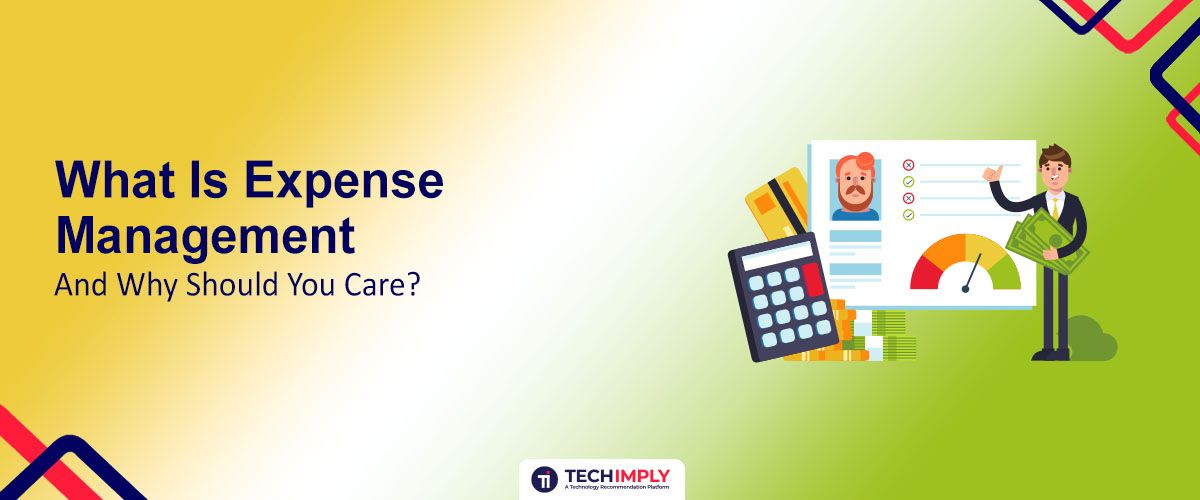
When you consider the financial health of your company, it is easy to think about big-ticket revenue targets and not the little holes in your bucket. The system adopted by your business to track, process, and pay employee-initiated spending is called Expense Management. Regardless of the size of the company (small or big), knowing how to control the costs at the company level is bound to make sure that each dollar invested in the company is used to generate growth and not wasted in administrative mess.

Looking for Expense Management Software?
Check out Techimply's List of the Best Expense Management Software in India. for your business.
Good Expense Management makes what was traditionally a boring task a competitive advantage. Up to this point, by streamlining your expense management process, you can have a clear insight as to where your money is going every minute. In the world of 2026, which is quite complex, the advantages of implementing an expense management system are obvious: it is about empowering your workforce and securing your margins.
What Is Expense Management and Can It Actually Save You Money?
In its very essence, what is expense management? It is a cumulative process of monitoring employee expenditure, approving such expenditures with company policy, and compensating them. Although it is easy to state, the loss costs of bad management are enormous. Studies indicate that manual processing may cost firms a lot of money on a single report because of human error and time wastage. By moving to a contemporary company expense manager strategy, you eradicate these invisible expenses from your resources.
Can it really make you save money, then? Absolutely. By best expense management practices, you avoid unnecessary payments, eliminate duplicates, and avoid fraudulent claims before they are disbursed. Most importantly, it enables you to make better deals with vendors since you are now able to present the data on the amount you are spending with them. The difference between estimating your budget and assuming what it is is business expense management.
Why is Expense Management Important?
Accuracy is all in the present-day fiscal environment. Expenses management is the checkpoint to your company's bank accounts. The finance department is basically driving blind without a proper expense management program because they will only realize how badly their credit card has been used until the end of the month when the bill arrives.
Besides, one of the major components of your Duty of Care is employee expense management. It makes sure that your staff is not out of pocket even for a long time, and this directly affects the faith of these individuals towards the organization. Today, when any business is supposed to be transparent in its financial dealings, a transparent process of managing expenses is an uncompromising requirement of any viable business.

Do You Know?
Firms that employ automated expense management systems save up to 78% in the cost of processing a single expense claim than through manual process.
What Are the Benefits of Expense Management?
Effective business expense management offers more than just a tidy ledger. It provides a suite of strategic advantages that can redefine how your business operates.
1. Improved Financial Viability and Control
You can't manage what you can't see. With proper expense management, you get a bird’s-eye view of departmental spending. This allows you to spot trends, like a sudden spike in travel costs, and address them immediately.
2. Reduced Costs and Increased Profitability
By identifying and cutting leakage, such as unused software subscriptions or non-compliant travel bookings, you directly increase your net profit. How to manage business expenses efficiently is often the fastest way to find money in your budget.
3. Enhanced Efficiency and Streamlined Workflows
Automation removes the bottleneck of waiting for a manager to sign a physical piece of paper. This streamlining means your finance team spends less time on data entry and more time on high-level analysis.
4. Enhanced Compliance and Reduced Risk
Standardized expenses management ensures that every claim meets tax and legal requirements. This keeps your business audit-ready at all times, reducing the risk of heavy fines.
5. Improved Employee Satisfaction
Nobody likes a month-long wait for a reimbursement. Modern employee expense management ensures that staff are paid back quickly, which keeps morale high and reduces friction between departments.
6. Better Decision-Making and Strategic Planning
Data is the fuel of 2026. When you understand your spending patterns through expense management consulting or internal audits, you can make smarter bets on where to invest your capital next year.
7. Scalability and Adaptivity
As your business grows, your old spreadsheets will break. A robust expense management program grows with you, handling 1,000 reports as easily as it handles 10. Don't let your profits slip through the cracks of a spreadsheet; take control of your business expense management now.
What are the Types of Expense Management?
There are generally two ways to handle your books: the old-fashioned way and the modern way. Understanding the difference is vital for business expense management.
1. Manual Expense Management
This usually involves physical receipts, Excel sheets, and a lot of back-and-forth emails. While it might seem free, it is actually the most expensive way to operate.
-
Time-consuming and error-prone: Manual data entry is a magnet for typos.
-
Lack of real-time visibility: You only see the spend weeks after it happens.
-
Increased administrative workload: Your highly-paid finance experts end up acting like data entry clerks.
-
Difficulty in enforcing policies: It is easy for an out-of-policy lunch to slip through the cracks.
-
Reduced employee satisfaction: The slow, clunky process frustrates everyone involved.
2. Automated Expense Management
This uses a dedicated company expense manager or software to handle the heavy lifting.
-
Increased efficiency and accuracy: OCR technology reads receipts so humans don't have to.
-
Real-time visibility and control: Managers can see and approve spend on their phones instantly.
-
Improved compliance: The system automatically flags anything that breaks the rules.
-
Enhance security: Sensitive financial data is encrypted and stored safely.
-
Faster reimbursements: Employees get their money back in days, not weeks.
-
Seamless integration: It talks directly to your accounting software (like QuickBooks or Xero).
-
Scalability and flexibility: Easily handles global teams and multiple currencies.
What are the Challenges of Expense Management?
Despite the good intentions, it can be challenging on how to control the company expenditures. Common hurdles include:
-
Lost Receipts: the dog ate my receipt is still a common excuse in most offices.
-
Mixed Up Policy: When it is 50 pages of legal gobbledygook, nobody is going to read your expense policy.
-
Fraudulent Claims: Padding an expense report is an issue that is easy to commit, but expensive.
-
Data Silos: When your travel data and your expense data fail to communicate, then you are going to lose the entire picture.
Another area that is likely to be confused is spend management vs expense management. Whereas expense management is concerned with reimbursements following the spend, spend management considers the whole life cycle of company money, which includes procurement and vendor payment.
What is an Expense Management Tool and Why Does Your Business Need One?
An expense management tool is a software solution designed to automate the entire expense management process. In 2026, these tools are no longer optional extras; they are the engine room of a modern finance department.
Your business needs these expense management tools because the volume of digital transactions is exploding. Between SaaS subscriptions, remote work stipends, and global travel, you simply can't keep up manually. These tools provide the best expense management results by creating a paperless, friction-free environment for your team.
The expense management software market size in 2026 is estimated at USD 8.48 billion, growing from 2025 value of USD 7.70 billion, with 2031 projections showing USD 13.82 billion, growing at 10.10% CAGR over 2026-2031.
What are the Benefits of an Expense Management System?
If you are still on the fence, consider these core advantages of an integrated system:
-
Streamlined efficiency and time savings: Auto-categorization of expenses saves hours every week.
-
Enhanced accuracy and reduced errors: Systems don't get tired, or make typos.
-
Improved compliance and fraud prevention: Automated checks catch duplicate receipts instantly.
-
Greater visibility and control over spending: Real-time dashboards show you exactly where you stand against your budget.
-
Faster reimbursements: Happier employees mean a more productive workplace.
-
Seamless integration with other systems: Connect your company expense manager to your ERP for a single source of truth.
Pro-tip
Review your eexpense policy every six months. As work habits change (like the rise of hybrid work), your allowed expenses should evolve to reflect your employees' actual needs.
Conclusion
Mastering Expense Management is about much more than just keeping track of lunch receipts. It is about building a culture of financial responsibility and operational excellence. By moving away from manual, error-prone methods and embracing modern expense management tools, you protect your cash flow and empower your employees. Whether you are seeking expense management consulting or looking for the best expense management software, the goal remains the same: total clarity over your company’s capital. The year 2026 demands agility. By optimizing your expense management process today, you ensure that your business is prepared for the challenges of tomorrow.