In today's world, there has been much discourse about data breaches due to people spending so much time online. It's one of the major problems facing the world today. We have dealt with breaches affecting individuals, corporations, and even state governments, with many being very well established. Organizations ranging from social media to banks have never been safe from any breach. Some crosses were just minor instances, while many stood out as catastrophic, breaching the data of millions or even billions of people.
Data breaches are among the biggest threats in cybersecurity that cause exposure to individuals and organizations' personal and financial information. Cybercriminals work with various techniques from phishing scams to unpatched software vulnerabilities as never before: this dynamic situation requires increased focus on security.
Then comes the worst of the worst in a series of analyses on the worst data breaches in history, which we will present. We'll assess the breach ourselves, where it went wrong for them, and what key protective lessons we have gained for ourselves in this digital world.
1. A great big whoop-de-doo! I'm thrilled. (2013–2014): 3 Billion Accounts Compromised
What Happened:
In between the years 2013 and 2014, Yahoo! has been victimized by the largest ever data breach in history. Initial reports of the breach emanated in the year 2016, and it was as late as 2017 that it was made known fully: hackers had pushed through to all three billion user accounts.
The whole thing started like this...
Investigators found that phony cookies let hackers slip into user accounts—passwords weren't necessary. State-sponsored actors were responsible for the security compromise. This means a government was involved.
Important things I discovered.
-
Being open is key. That's fantastic news! I am thrilled. delayed disclosing the full extent of the breach, damaging its reputation and trust with users.
-
Comprehensive Security Audits Are Essential: Companies need regular, thorough security assessments to identify weaknesses—before hackers do.
-
Encrypt Sensitive Data: While Yahoo! hashed passwords, better encryption and protection of security questions could have limited the damage.
The recent security breach really drives home the point: poor encryption methods are a major risk. What scares us the most. Both individual privacy and business security matter.
2. Equifax (2017): 147 Million People Affected
What Happened:
An Equifax breach resulted in the theft of personal information of 147 million Americans, including social security numbers, dates of birth and addresses, and, in some cases, driver's licenses.
How It Happened:
Hackers patched Equifax's access using a vulnerability in Apache Struts, the web framework that many sites use; the fault had been flagged to Equifax months beforehand but remained unfixed.
Lessons Learned:
-
Patch Management Is Mandate: Keeping software up-to-date with patches is a prime defense against known threats and exploits.
-
Limit Data Retention: With so much data in the way of Equifax, it became a target of choice. Any time before putting in storage, think about whether you need to keep it at all. That, among other things, leads to data overload, which is detrimental; reducing to just that information that is really required makes life easier and safer for the organization.
-
Incident Response Plans Matter: Because of the dormant response on Equifax's part and bad customer support, the perception of the public only worsened. The only way chaos won't stand a chance is if you're prepared for everything. You won't have any surprises if you at least practice your response.
It is a big issue to ignore known security holes. The bigger concerns are ours. We can't stress how important organizational security is; Equifax is an example.
3. Marriott International (2014–2018): 500 Million Guests Affected
What Happened:
Attackers breached Starwood Hotels’ reservation system in 2014, long before Marriott acquired Starwood in 2016. 2018 was when they finally found the breach. Personal information—names, addresses, passport numbers, and encrypted credit card data—was compromised in the hack. This is serious stuff.
How It Happened:
The breach went unnoticed for years. Starwood's systems were compromised; malware and remote access tools did the damage.
Lessons Learned:
-
Cyber Due Diligence in Mergers and Acquisitions: Acquiring a company? Make sure you know how secure they are first.
-
Continuous Monitoring: Detection tools and regular system checks are essential for spotting unusual activity.
-
Encrypt Data Effectively: Even encrypted data can be vulnerable if keys are not managed properly.
Ignoring system alerts and failing to spot intrusions quickly explains why dangerous, advanced attacks are such a problem. What scares us the most. Cybersecurity is a major concern; it affects us all.
4. Target (2013): 40 Million Credit Card Numbers Stolen
What Happened:
Hackers gained access to Target’s point-of-sale (POS) systems, stealing credit and debit card details of over 40 million customers. Additionally, personal information for another 70 million individuals was compromised.
How It Happened:
Attackers gained entry through a third-party HVAC vendor with weak credentials. Once inside, they moved laterally through Target’s network until they found the POS systems.
Important things we discovered.
-
Third-Party Risk Management: Vendors and partners can be the weakest link. Make sure to regularly review the security practices of any outside companies you do business with; this is a must.
-
Network Segmentation: Sensitive systems should be isolated from the rest of the corporate network to limit attackers’ ability to move laterally.
-
Monitor for Anomalous Behavior: Intrusion detection systems could have flagged the attackers’ movements sooner.
One of the biggest ongoing concerns? Problems with outside vendors and vulnerable supply chains. What scares us the most. Modern companies have a lot on their plates. It's a competitive landscape out there.
5. Facebook (2019): 533 Million Users' Data Leaked
What Happened:
A massive trove of personal data from 533 million Facebook users appeared online for free. It had everything: names, locations, and even phone numbers. Lots of information.
How It Happened:
The data was scraped from Facebook’s platform using legitimate features designed to help users find friends. Malicious users found ways to take advantage of the features; this caused problems.
Lessons Learned:
-
Secure API Endpoints and Features: Even legitimate tools can be exploited. Keeping a close eye on things and limiting who can see the data is really important.
-
Data Minimization: Collect only the data necessary for services. Fewer records mean less to lose in a data breach.
-
User Education: Teach users about privacy settings and how to control their personal data.
Data scraping and exploiting legitimate features? This breach proves they're growing threats. Our most serious problems. User privacy matters to us.
6. Capital One (2019): 106 Million Individuals Affected
What Happened:
An attacker compartmentalized the entry into a cloud storage system of Capital One and made available personal data of 106 million customers. This personal data include names, addresses, credit scores, and bank account details.
How It Happened:
The attacker took advantage of a misconfigured firewall in Capital One's Amazon Web Services (AWS) cloud setup to gain illicit access to Sensitive Financial Records.
Lessons Learned:
-
Cloud security matters; it can expose huge piles of data due to misconfigurations in cloud environments.
-
Insider Threats Are Real: The hacker has been an ex-AWS employee. User access control should thus be tight.
-
Encryption in Rest: Always put sensitive financial data in an encrypted format so that unauthorized access will not be possible:
-
Cloud misconfigurations and insider threats: Very serious threats, I think the worst from all of these. Priority. Cloud security.
What These Breaches Teach Us About Cybersecurity
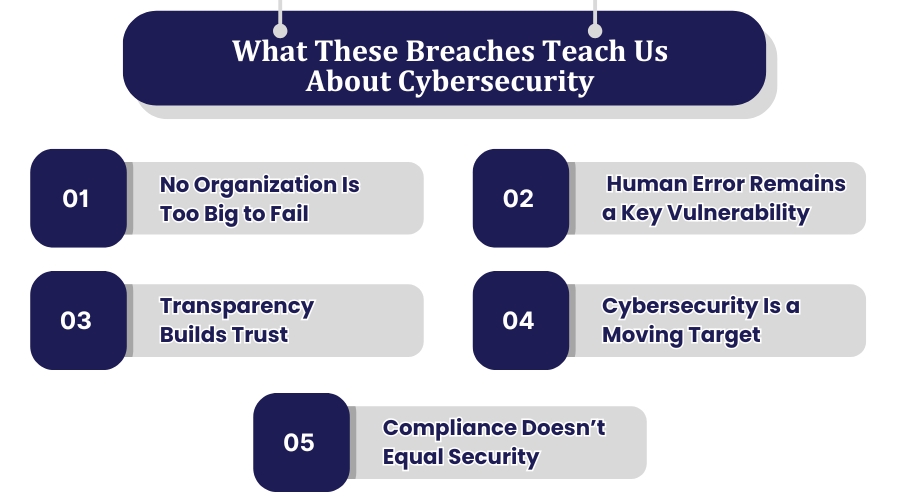
1. No Organization Is Too Big to Fail
Even the largest, most sophisticated organizations can fall victim to a data breach. Assuming “it won’t happen to us” is a dangerous mindset. Proactive cybersecurity strategies must be part of every organization’s culture.
2. Human Error Remains a Key Vulnerability
From unpatched software to weak passwords, human oversight continues to play a role in many breaches. Following safety rules and investing in security awareness training for employees can significantly reduce these risks. Human error is a big problem—and what scares us the most. Every cybersecurity software needs this layer of protection.
3. Transparency Builds Trust
Delays in reporting breaches or downplaying their impact erode public trust. Honest, upfront talk keeps things above board and empowers customers to protect their interests.
4. Cybersecurity Is a Moving Target
Attackers are constantly evolving their methods. What works today may not be enough tomorrow. Cybersecurity needs constant upgrades. This means investing in better tools, technology, and skilled people. Outsmarting hackers is a constant challenge. What scares us the most. Companies need to stay alert; problems are always popping up.
5. Compliance Doesn’t Equal Security
Meeting regulatory standards is important, but it’s only a baseline. Security goes beyond simple compliance. A robust, flexible security setup is what matters.
Be Smart. Stay Safe
Data breaches are a constant risk, but there are ways to make yourself an unappealing target. Fortify your passwords, use two-factor authentication, and think before spilling the beans about your personal life online.
Businesses should take additional precautions when it comes to actual data encryption, fixing loopholes in their security, and being upfront about what's gone wrong. No system can be 100 percent failure-proof, but careful watch can make a difference.
Final Thoughts
The history of major data breaches offers a stark warning: cybersecurity cannot be an afterthought. More sophisticated threats mean stronger security is needed. Everyone – from individuals to large corporations – needs to guard their private data. Big or small, every company needs to be on guard. Data breaches teach us to stay informed and prioritize security. It's a must.
Understanding and preparing for the biggest threats in cybersecurity is no longer optional—it’s a necessity. The next breach could be just around the corner. Will you be ready?