

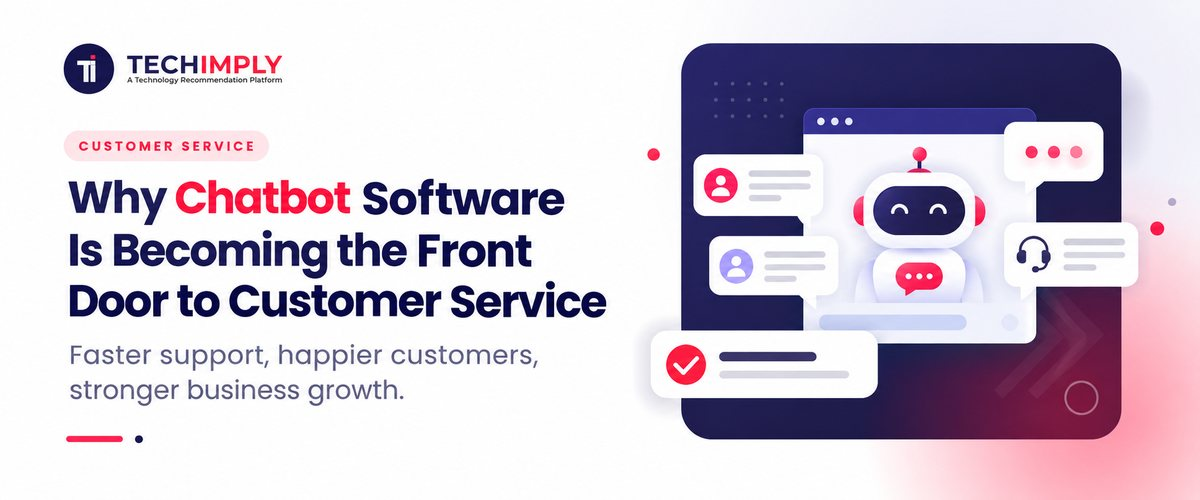
In the Indian market, chatbot software has evolved from a simple FAQ popup to the definitive front door for enterprise customer-support services. Powered by rapid digital adoption across Tier-2 / Tier-3 cities, smartphone proliferation, and adoption of messaging channels like WhatsApp, Indian consumers are demanding instant support, 24x7, round-the-clock, and without waiting in a queue. Advanced conversational AI capabilities are helping chatbots evolve into multilingual superstars, handling everything from tracking e-commerce orders and UPI instant refunds to banking KYC processes, helping screen and resolve up to 80% of customer inquiries at the first point of contact. This not only helps reduce overheads for enterprises but sets the tone and tenor for the entire consumer-interaction lifecycle.
What Exactly Is Chatbot Software?
Chatbot software refers to a computer program that communicates with users through text or voice and allows businesses to automate interactions across text and voice channels.
Rather than a customer having to call or email a business and speak to a person, companies can deploy a chatbots software to help their customers. Modern chatbots are more sophisticated than being just menu-driven. Instead, they leverage natural language processing algorithms to determine customer intent within context and dissect multifarious questions for delivering the appropriate response at the precise time. Because of the features added by modern technology in this modern world, Artificial Intelligence is essential to every business. We must express that companies that are actively employing these advancements in technology receive significant benefits.
They allow not only to optimize existing processes and reduce costs but also to ensure a more efficient workflow. Nevertheless, one should remember that progress requires time, and for the business environment, such a factor as innovation is vital. That is why it is so important to train and motivate employees to implement new solutions in the daily operations of the company, as well as properly use the opportunities provided by modern technologies.
Did you know?
In 1966 at the MIT Lab, Computer Scientist Joseph Weizenbaum created the first-ever chatbot software called ELIZA that could impersonate a psychotherapist by communicating with users in the form of questions. Today, chatbot software can manage over 100 billion dialogues per year across different platforms, and enterprise chatbots can resolve up to 80% of customer inquiries at the first point of contact without human assistance.
What Role Do Chatbots Play in Customer Service Today?
Chatbot software is rapidly evolving from a cost-saving exercise into the front-end of customer support services. With millions of first-time digital consumers entering the market in Tier-1, Tier-2, and Tier-3 cities, enterprise call centers and support teams are grappling with massive surges in customer inquiries. Chatbots are being employed to act as the first responders across channels like WhatsApp, Web, and mobile event apps, resolving high-frequency, high-volume requests instantly. Whether it is checking a Flipkart or Amazon order, booking a RedBus ticket, or a simple query of bank balance over WhatsApp Banking, chatbots are being relied upon to handle these transaction-heavy, high-volume requests instantly, with zero wait for customer helpline calls
Modern chatbots act as triage, helping to sort out consumer inquiries and delegating more complex ones to humans, thus enabling customer-support teams to tackle high-value, higher-complexity issues. With integration into native conversational AI systems that are trained to understand the intricacies of the Indian consumer, chatbots are able to handle code-mixed languages and understand consumer intent accurately. With the authentication of the user via OTP, the bot attends to simple requests and resolves 70-80% of customer inquiries end-to-end. When a query is fairly complicated, the chatbot transfers this to the right human agent with the conversation transcript, saving time on both sides. A combination of human expertise and efficiency driven by AI, this offers each customer a contextual, personalized high-touch experience while providing enterprises with the agility to scale up their support needs at an extraordinary pace.
Why Are Indian Businesses Rushing to Adopt Chatbot Software?
1. Massive digital onboarding beyond Tier-1 cities
Now, in Tier-2, Tier-3, and rural India, the hundreds of millions of first-time digital consumers are emerging. With chatbot software, enterprises can quickly ramp up their support while minimizing call center software staffing outlays.
2. WhatsApp Business
With over 500 million WhatsApp users in India, businesses are rushing to provide services on WhatsApp, where the user spends the majority of their mobile screen time.
3. 24x7 availability without idle overheads
Modern-day consumers are far more empowered and have higher expectations from brands, with chatbot software being able to provide round-the-clock support with zero overheads on night shifts for answering frequently asked questions.
4. Code-mixing and multilingual support
With a diverse consumer base, Indians speak a multitude of languages and dialects. Modern AI chatbot solutions can be deployed to communicate with customers in their preferred languages and dialects, including code-switching.
5. UPI and digital payments
Seamless integration with India's digital payments infrastructure allows chatbots to execute commercial transactions like instant refunds, utility bill payments, and net-banking transactions.
6. Cost-cutting
Chatbot software reduces cost per ticket by up to 50%, significantly cutting down on the costs associated with customer-support services like voice call centers.
7. Personalized lead generation
Hyper-personalized lead generation. The state-of-the-art chatbots have taken lead generation to a new level.
8. Onboarding verification
Chatbots can be used to speed up KYC processes, helping guide customers through eKYC and video KYC processes for faster verification.
How Do Chatbots Actually Improve Customer Experience in India?
Chatbot software improves the overall customer experience by removing friction from the support process, offering hyper-localized support, and reducing resolution times:
1. Zero wait-time (Instant gratification)
No more listening to call-center music while waiting for help when you are in India. Chatbot software provides an instant response to frequent and simple customer queries, which can help solve operational inquiries quickly.
2. True multilingual comfort
Modern AI-powered chatbots can now overcome the language barrier, conversing fluently in several Indian languages and dialects for an enhanced experience. The bot understands the consumer intent accurately, even when the user communicates in a code-switched or mixed script.
3. 24x7 availability around local festive cycles
Whether it is midnight or a public holiday, the bot is available to assist. Indian consumers can complete a transaction, ask for a refund, or block a lost credit card instantly without having to wait for the next business day.
4. In-app transaction convenience
By allowing customers to effectively conduct a transaction through messaging platforms like WhatsApp, users will no longer need to download any platform.
5. Contextual escalation
In case the chatbot has to pass on a stressed case to a human agent, the history of the previous conversation will also be made available, which will save the customer from the necessity to repeat the previously submitted information.
6. Pro-active engagement
Unlike a customer, the chatbot will also be able to track, for instance, any delayed flights and automatically notify customers.
What Are the Key Benefits of Chatbot Software for Indian Companies?
Chatbots can help reduce support costs by up to 50%, significantly lowering costs per ticket, especially for repetitive customer inquiries.
1. Hyper-local reach
AI-powered chatbots can communicate in local Indian languages, helping enterprises drive sales by targeting millions of potential buyers in Tier-2 and Tier-3 cities.
2. Higher sales conversion
Modern chatbots can help serve as conversational sales agents, retargeting abandoned carts and qualifying leads for sales follow-ups. Chatbot software can also help execute instant checkout, especially when deploying solutions on WhatsApp Business.
3. 24x7 uninterrupted operations
With sub-second response time across channels, chatbots ensure round-the-clock customer support, which is crucial during festive sale rushes and higher spikes in customer inquiries.
4. Seamless payment and refund processes
With deep integration into India's digital payments ecosystem, chatbots can process instant refunds, UPI transactions, and recurring payments for subscriptions.
5. Rapid document verification and onboarding
Chatbots can help fast-track critical administrative processes like verifying a PAN card, capturing phone numbers, and capturing Aadhaar details for KYC verification.
6. Zero-friction fallback to live agents
When dealing with complex issues, chatbots can be programmed to escalate to the right support agent, preserving context and conversation history, to ensure faster resolution of high-touch issues.

Pro-tip
To maximize ROI, avoid launching a generic bot on your website with poor traffic. Rather, launch the chatbot on high-engagement channels like WhatsApp or Instagram where users spend more mobile screen time, and where your bot can enjoy higher open rates (up to 90%). A critical design choice is to ensure human-in-the-loop fallbacks that ensure the bot immediately escalates complex issues to a live agent rather than looping the customer. Though it is important to ensure cost savings, it is equally important to keep a tab on conversion metrics with respect to abandoned cart recovery, lead qualification in regional languages, and first-contact resolution times to ensure business value.
What Challenges Do Businesses Face When Implementing Chatbots in India?
While the advantages of chatbots are numerous, companies in India face challenges in adopting chatbot technology.
1. The challenge of deciphering the different regional dialects
With a truly diverse linguistic landscape, it is difficult to develop an AI chatbot to be able to understand dialects, complex phrases, and code-mixing.
2. Handling unstructured queries
Indian customers frequently use informal or unstructured phrasing in asking questions or switch context mid-conversation.
3. Integration into legacy systems
Mid-size or traditional Indian enterprises may rely on legacy internal CRMs or ERPs, and integrating a modern chatbot API may prove challenging.
4. Balancing consumer privacy and enterprise intelligence
In the present times, emphasizing data privacy, it is vital for organizations to maintain a balance between maintaining consumer information and using it for improving customer service. The Digital Personal Data Protection (DPDP) Bill 2023 is targeted at providing consumer data privacy in the digital world.
5. Managing consumer expectations
A significant portion of Indian consumers have negative perceptions of chatbots. When a bot fails to understand a particular context, the consumer is likely to become frustrated and request to speak to a human agent immediately.
6. API costs on high-volume channels
Using enterprise chatbot solutions could prove to be costly on channels like WhatsApp Meta Business APIs during the Diwali season if message volume and API token costs are not monitored carefully.
7. Avoiding hallucinations and disinformation
Sophisticated AI chatbots may produce fabricated information while giving clients wrong details on critical areas such as specifications, policies, and benefits, thereby harming the organization's reputation.
Conclusion
Chatbots have become an important avenue for businesses, allowing them to provide effective and profitable customer service. As automated solutions continue to disrupt the sector, it is vital that firms get the appropriate solutions in line with their requirements. Techimply is at your service to help you find the best solution at India's best B2B marketplace.