
Two members of a company’s finance department can ask for information on their own expenses from last year; however, there may be discrepancies between them as they have access to different data sets. It wasn't due to an error by any of them; rather, it is simply that someone entered Travel as a travel expense while another did so for miscellaneous expenses without specifying whether they were more appropriate or not.
Such discrepancies are often overlooked by auditors during their review process, and investors at times when they ask about bookkeeping errors between years. The chart of accounts is there to prevent this issue. COA is usually an experience someone has had before. What a COA actually is, how its structure and numbering work, what a sample layout looks like in practice, and how accounting software changes how much of this you need to manage by hand.
What Is a Chart of Accounts? (COA Meaning Explained)
COA meaning is something simpler than it implies: an accounting statement or code sheet called accounts that lists all types of accounts that companies use for recording their finances. Each rupee moving through a company, like incoming cash from customers or outgoing bills to vendors, is recorded on its own account instead of being scattered everywhere without labels.
Put simply, a COA is the index for a company's books. Accountants use it to post transactions consistently. Financial statements, the balance sheet and income statement included, are built directly from the account balances it organises. Without one, two people recording the same type of expense could easily label it differently, and that's exactly the inconsistency problem described above.
Do You Know?
The accounting system varies from country to country rather than being standardized, as many believe. Most of them are designed differently from others, like those in India, where they have their own unique structure for accounting purposes while still being subject to some standardization requirements imposed upon them, rather than having an entirely rigid model as is required elsewhere.
Why a Structured Chart of Accounts Actually Matters
An unstructured or inconsistent COA often causes issues which manifest themselves later on. There are reports that do not match between these two time periods. It is difficult to compare this year's spending with that of last year since there was no way to track changes between them. An employee who is hired to handle accounts payable will create an entirely new account for what was previously existing but under another name; at present, this same amount of money is being divided between two separate ones.
COAs are designed to avoid such issues altogether. Each account has a single address; uniformity of numbers allows for comparison between periods while someone retrieving financial information is aware precisely what they need to find out without any doubt. This has nothing to do with bureaucracy itself. This is how it makes them reliable to us.
The Five Core Account Categories
Almost all companies have a set of five main types. Cash, accounts receivable, inventory, and equipment are assets of a company that it owns or has control over. Liabilities include debts such as unpaid bills, loans, and other liabilities owed by a company to suppliers or creditors.
Equity is an owner's share after deducting liabilities from assets. Income is also called revenue; it refers to funds generated by a company through its primary activities. The expenses include costs associated with operating an organization, such as salaries for employees, office space rental fees, advertising expenditures, etc., whereas expense tracking software is integrated within these categories instead of being treated separately.
Asset management is a part of Fixed Asset Accounting under an organization’s total assets list. Asset management discussion is usually started at this point. In general terms, fixed assets have their own category because they are part of an organization’s financial statement, such as buildings, machinery, vehicles, etc., which should be separately accounted for due to proper allocation of expenses like depreciation on them.
Accounts receivable and accounts payable are also applicable here. Each is an independent account by itself; however, as transactions increase beyond what a single line item can effectively monitor, it usually has its own separate ledger.
How COA Structure and Numbering Work
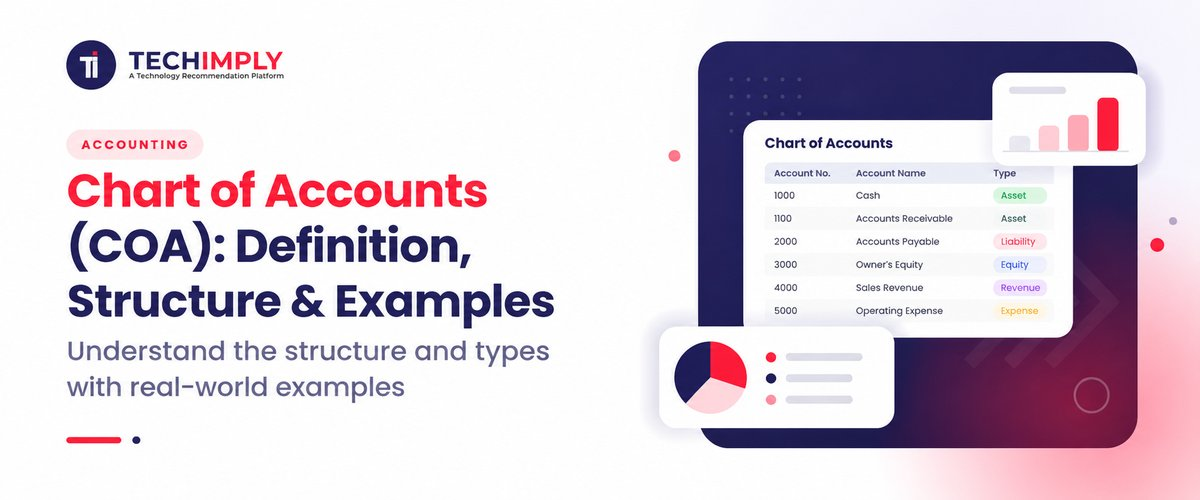
Most charts of accounts use a numbering convention that groups accounts by category, with gaps left deliberately for future additions. A common version looks like this:
|
Number range |
Category |
Typical accounts |
|
1000-1999 |
Assets |
Cash, accounts receivable, inventory, equipment |
|
2000-2999 |
Liabilities |
Accounts payable, loans, outstanding dues |
|
3000-3999 |
Equity |
Owner's capital, retained earnings |
|
4000-4999 |
Revenue |
Sales revenue, service income |
|
5000-5999 |
Expenses |
Payroll, rent, utilities, marketing |
In a given area of business, there is often some space for each account instead of consecutive numbering. Instead of using 1001, 1002, and 1003 with numbers 1010, 1020, and 1030, there would be room for adding another account later without having to change all subsequent entries. This is just an insignificant thing; however, ignoring this would be one of many times when maintaining such structures can become difficult after several years.
A Sample Chart of Accounts
For instance, an example of a small service company would be 1010 for cash, 1200 for accounts receivable, 1500 for office equipment, 2010 for accounts payable, 2300 for a business loan, 3010 for owner's capital, 4010 for service revenue, 5010 for salaries, 5200 for rent, and 5400 for marketing expenses.
In a company that sells products manufactured through factories as well as trades for them, there is usually an increase in details about stock levels and costs incurred while producing items because these differ from each other despite being listed together under 'inventory' and 'cost of goods sold'. Exact details depend upon what a company is interested in tracking rather than simply copying another organization’s model completely.
Where Accounting Software Changes the Picture
Creating an account ledger manually on paper remains popular among Small companies today; however, most accounting programs come pre-installed as standard templates which are then modified instead of created from scratch. This saves time, though the default template still needs review. A generic template built for a retail accounting business will have accounts a services firm never needs, and vice versa.
Some accounting software, particularly newer AI accounting tools, can now suggest where a transaction belongs based on past entries, and AI accounting features along these lines are becoming a standard part of what mid-tier platforms offer, flagging when a new account looks like a near-duplicate of an existing one, and catching miscategorised expenses before they distort a report. None of this replaces a properly thought-out COA structure to begin with. It just reduces how much manual cleanup happens afterward.

Pro-tip
Firstly, before you adopt an accountant’s standard cost of acquisition (COA) form for expenses, list out at least three to four biggest ones on that sheet. Customize it if the category doesn't reflect what the organization is spending, rather than waiting years to see where funds go when they're posted to incorrect accounts.
Common Mistakes When Setting Up a COA
Many people create too many accounts at once. Five employee businesses usually do not need 15 types of expense management accounts; a very detailed cost accounting system would be difficult to manage compared with that. On the other hand, grouping everything into a covering category such as Miscellaneous or Other Expenses leads to exactly what we want to avoid being reported on by a company accountant (COA).
Renumbering accounts during a year, instead of creating more at places where there are no existing ones, would be better. Breaks comparability across different times for historical records that are difficult to reconcile with present-day data; this problem often arises when there is an audit or a loan application process involved.
Keeping a Chart of Accounts Useful as the Business Grows
COAs that work well for small companies often do not remain effective as their size increases due to higher numbers of employees, more complex finances, and greater expenses. Annual review helps catch duplicates and prevent categories from growing out of control so that we don't have to do an actual clean-up later on.
Financial risk management is an important aspect of business operations that many companies ignore because they don't have enough information at their level; therefore, they rely too heavily on estimates instead of real figures. Reliable information about finances through accurate and consistent classification ensures effective risk management reports, cash flow forecasts, and auditing processes instead of being hastily prepared when required.
Conclusion
The chart of accounts is an easy concept that supports most other aspects of accounting for businesses' financial statements. Five main types, an even numbering system, and sufficient discipline for avoiding duplicates or vagueness are adequate requirements that most need for a COA to function properly. Correctly getting it done now is much cheaper compared to repairing later when there has been too long an accumulation of poor quality information over time.