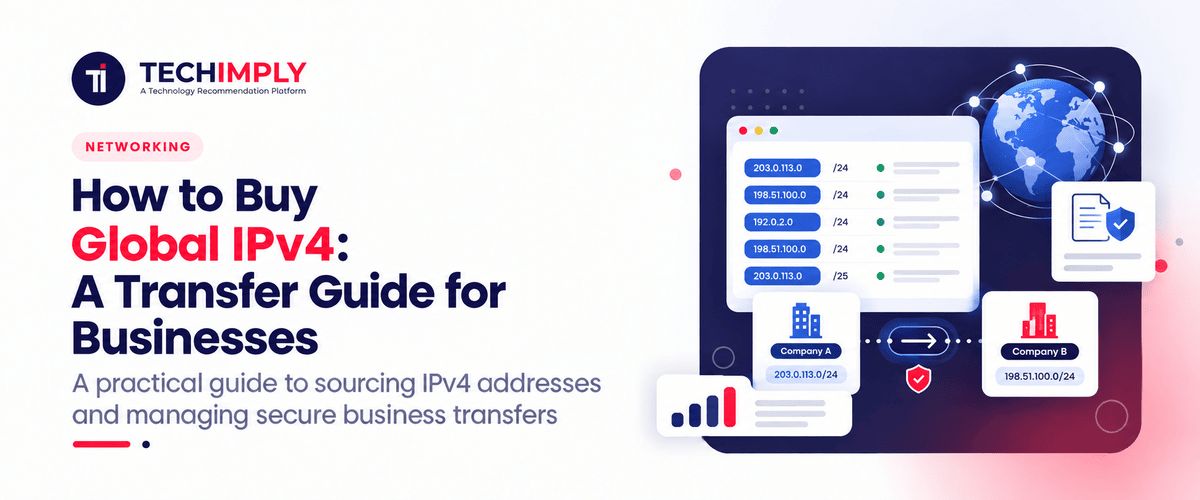
To buy global IPv4, a business acquires the registration rights to an address block from its current holder through a transfer recorded by a Regional Internet Registry (RIR), such as ARIN, RIPE NCC or APNIC. The registry has to approve the recipient and record the change before the block is yours to route.
Fresh IPv4 supplies at the registries are largely exhausted, but customer-facing apps, mail servers, VPN endpoints and partner integrations still need publicly routable addresses. This guide walks through the transfer process from sizing the request to bringing the block online, with the full cost of ownership in view.
Key Takeaways
- Plan around a /24 for independent routing, since smaller blocks are commonly filtered by other networks.
- In the ARIN region, request pre-approval based on a documented 24-month need before you negotiate.
- Vet the exact block for registration, routing records, blocklists and geolocation before committing.
- Budget beyond the purchase price for registry fees, escrow and ongoing network operations.
- Routing records, reverse DNS and reputation monitoring need upkeep after the transfer.
Step 1: Right-Size Your Request
IPv4 blocks use CIDR notation: a /24 holds 256 addresses, a /23 holds 512 and a /22 holds 1,024. A smaller number after the slash means a larger block.
For a block you plan to announce independently, a /24 is the practical minimum, since many networks filter smaller routes such as a /25. Confirm your upstream provider's routing requirements before choosing a size.
Match the block to real service needs. A few web services behind a load balancer may only need a handful of provider-assigned addresses, while hosting providers that give customers dedicated IPs may need larger blocks backed by documented growth.
Step 2: Meet the Registry Prerequisites
The registry's requirements run alongside the commercial deal, so address them early.
ARIN region. You need an ARIN organization identifier (Org ID) matching the legal entity that will receive the addresses, and you must sign the applicable Registration Services Agreement (RSA). ARIN evaluates recipients under section 8.5 of its Number Resource Policy Manual, which covers section 8.3 transfers within the region and section 8.4 transfers between regions. You can request pre-approval based on a documented 24-month need before you sign a purchase agreement.
ARIN's waitlist for returned space is not a substitute for buying. Availability is uncertain, waitlist addresses carry a 60-month transfer hold and recipients must wait 90 days before reapplying.
Other regions. RIPE NCC and APNIC transfers follow each registry's own policies and documentation. APNIC space delegated from 103/8, for example, cannot be transferred within five years of delegation. A transfer between regions needs both registries' policies to allow it, so confirm both before you negotiate.
Step 3: Choose Where to Buy
Businesses usually buy through brokers, marketplaces or private sellers. Compare what each offer includes, not just the price per address.
Marketplaces and brokers. Brokers connect buyers with sellers and may manage transfer paperwork for a fee. Marketplaces sell through fixed-price listings, auctions or both; fixed prices make budgeting easier, while auction prices and timing are less predictable.
Some marketplaces bundle vetting and transfer support into each listing. IPv4 Connect, for example, sells blocks at fixed prices with a free blacklist report covering more than 100 global blacklists for every subnet. It removes old BGP announcements, route records and DNS entries before a block transfers, offers geolocation support and manages transfers with pre-approval assistance in the ARIN, RIPE and APNIC regions, with payment by secure wire or escrow.
Private sales. A vendor or a company winding down may have unused space. A private deal can avoid intermediary fees, but you take on verifying the seller's authority, drafting the contract and coordinating registry requests.
ARIN Qualified Facilitators. ARIN publishes a list of organizations in its Qualified Facilitator Program, which is a useful starting point when comparing transfer help. Ask every provider for an itemized estimate covering the address price, registry charges, service fees and escrow, and which costs are non-refundable.
Step 4: Run Technical Due Diligence
An IPv4 block carries a history that can affect email delivery, location-based services and whether other networks accept your routes. Complete these checks before you make a binding commitment:
- Ownership: Use the registry's Registration Data Access Protocol (RDAP) lookup to confirm the registered organization, block boundaries and contacts. The holder should match the entity signing your contract, or the seller should document the difference.
- Routing records: Check Internet Routing Registry (IRR) records that tie the block to the seller's network, and agree who will remove them and create yours.
- RPKI status: Route Origin Authorizations (ROAs) name the networks allowed to announce a block. If existing ROAs cover only the seller's network, your announcement could be rejected as invalid.
- Blocklists: Check the range against reputation sources such as Spamhaus, and treat every report as a snapshot rather than a lasting result.
- Geolocation: Commercial databases may still place the block in the seller's location. Ask whether the seller maintains a geofeed and has submitted corrections to providers such as MaxMind.
- BGP history and reverse DNS: Review past announcements for unexplained origin changes, and confirm who will hand over reverse DNS delegation.
Step 5: Set the Contract and Escrow Terms
Have counsel review the purchase agreement and escrow terms. The agreement should cover:
- The exact CIDR blocks being transferred, not just an address count.
- The price, payment schedule and who pays each fee.
- Registry approval as a condition of closing.
- Deadlines for removing old routing records, replacing ROAs and handing over DNS.
- The seller's authority to transfer and disclosure of any leases or claims.
- Remedies if blocklist entries or routing conflicts appear before closing.
Tie escrow release to confirmation that registration has transferred. Under Escrow.com's IPv4 terms, the buyer can no longer reject the deal once the receiving registry's Whois shows the buyer as registrant, so finish reputation and routing checks before the seller submits the transfer.
Step 6: Complete the Registry Transfer
Follow the registry's current instructions for your transfer type. In the ARIN region, both parties submit their requests through ARIN Online, and ARIN reviews the seller's authority and the recipient's eligibility even when the buyer holds pre-approval.
Keep the legal entity name consistent across the contract, Org ID and corporate records. For a transfer between regions, allow time for both registries to review it.
Step 7: Bring the Block Online
Registry approval completes the registration change, not the deployment. Work through these tasks with your network provider before announcing the block:
- Publish ROAs for the autonomous system number (ASN) that will originate the route, which may be your provider's rather than your own.
- Create IRR route records in a registry your upstream accepts, and confirm the seller's old records are gone.
- Set up reverse DNS delegation and hostname records; for mail hosts, make sure forward and reverse DNS agree.
- Announce and verify reachability from several external networks and public routing views.
- Build mail reputation gradually by starting with low volumes and watching delivery results.
- Update geolocation records and submit corrections to the databases your users rely on.
Routing filters, DNS caches and RPKI validators take time to update, and geolocation databases follow their own schedules. Verify each change rather than assuming it is visible immediately.
Step 8: Calculate the Total Cost
Build the estimate around current quotes and registry fee schedules rather than historical market averages.
|
Cost item |
Type |
What to include |
|
Purchase price |
One-time |
The quoted price for the exact block |
|
Registry transfer charges |
One-time |
Current processing and recipient fees |
|
Annual registration |
Recurring |
The fee tier for your total holdings |
|
Broker, marketplace and escrow |
Per transaction |
All quoted service charges |
|
Network operations |
Recurring |
Routing support, DNS and reputation monitoring |
Compare like for like. At an illustrative rate of $0.005 per address per hour, one continuously billed address costs about $43.80 a year and 256 cost about $11,200, but that comparison only helps if you need all 256. A service needing four public addresses would spend about $175 a year at the same rate.
Cloud providers such as AWS and Google Cloud set their own address and bring-your-own-IP rules. If you are still choosing a platform, comparing cloud providers on their BYOIP terms belongs in the same exercise.
Step 9: Decide Whether to Buy at All
Buying suits steady, long-term demand for a substantial block and mail-heavy services that need stable addresses. Provider-assigned addresses or a short-term lease suit seasonal workloads or uncertain growth, and private addressing with NAT and IPv6 covers internal and outbound-only traffic.
In a lease, the lessor keeps registration control, so review renewal terms, routing permissions and abuse responsibilities. Deploying IPv6 alongside IPv4 can ease future pressure, but it won't remove the need for IPv4 to reach systems that remain IPv4-only.
A Manageable Business Project
A sound IPv4 purchase starts with a justified need and a confirmed deployment path. Establish transfer eligibility before negotiating, investigate the block before committing funds and define the handover before closing.
Assign owners for routing records, reverse DNS and reputation monitoring before the block arrives. With those responsibilities clear, buying IPv4 becomes a planned infrastructure project rather than a search for the lowest price.