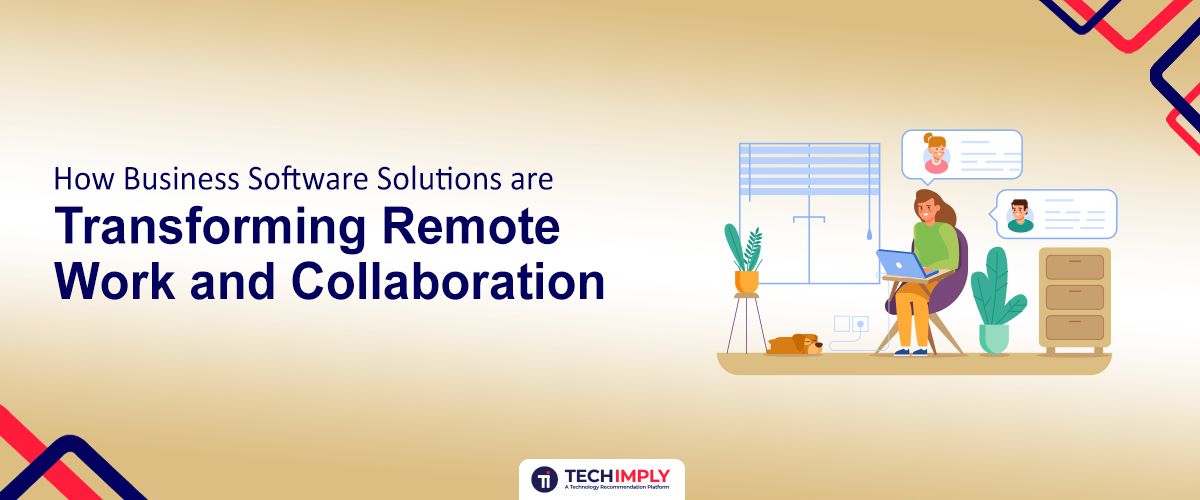
How Business Software Solutions are Transforming Remote Work and Collaboration
When working remotely used to be the exception, not the rule, collaboration software was an afterthought–big, awkward, unintegrated, and secondary to in-office interactions. Fast-forward now, and the tale has been completely reversed. Companies have prospered without physical centers of operation, team members live across multiple geographic time zones, and work days no longer exist within 9-to-5 constraints.
At the center of this revolution is a set of business software solutions tailored for the age of remote work. They don’t replace office procedures, but rather they redefine them. Live document collaboration to virtual brainstorming whiteboards, new software platforms are turning remote work into a high-performance highly collaborative ecosystem. As Matt Mullenweg, CEO of Automattic, says, ‘Technology is best when it brings people together.’
But the point is that these applications aren’t merely altering where we work but rather how we work, and maybe even more significantly, how we communicate, share innovation, and remain efficient even outside of the same physical space.
The digital backbone of the remote workforce
The single most important factor in successful remote work isn’t fancy equipment or coffee shop Wi-Fi. It’s the software stack. Businesses are realizing that the right tools can bridge not only geographical gaps but also cultural and operational divides.
In the early days of working remotely, software adoption meant survival. Video conferencing? Yes. Messaging app? Yes. File-sharing tool? Yes. But this ‘patchwork’ solution brought headaches along with it. Yes, they were good solutions, but there were also multiple logins, inconsistent user interfaces, and perpetual context-switching.
Now the attention is going towards combined solutions integrating activities, lowering friction, but indeed making work better than it used to be in the office.
Want some recommendations to make your work more centralized when it comes to communication?
-
Unified communication hubs like Slack and Google Chat combine chat, file sharing, and integrations with hundreds of other apps in one place.
-
Cloud-based document suites like Google Workspace allow simultaneous editing, version tracking, and secure file storage.
-
Project management software such as Asana, Trello, and ClickUp put a light on all activities, deadlines, and deliverables.
And what is the final outcome? Teams are no longer ‘making do’ with working remotely, nor is this an option when they’re sick or unable to come to the office. Working remotely is now a new norm. People are working together at velocities their pre-pandemic selves can only envy.
Streamlining collaboration with specialized tools
Where communication platforms form the basis of telecommuting, custom applications constitute its very highly coordinated nervous system. They are solutions at the micro-level for reducing friction in the daily workflows, which is usually made of work which takes out time and mental capacity.
Take document management for example. PDFs are the universal language of contract documents, reports, and slide shows in a remote-first business. And how many times have you wanted to remove just that one page away from a PDF file and weren’t able? Can this even be done without breaking the layout or having to download an uncomfortable application?
That’s where software like Smallpdf page remover comes in. With it, you can choose and remove any page in your PDF in a matter of clicks. There’ll be no fussy software, no messy workflows. You can erase pages without disturbing the formatting, pictures, or layout. Everything stays businesslike. And on the plus side, you don’t have to download any application or program. At Smallpdf site you can do everything, and it doesn’t matter from which device you’re logged in since they’re all supported.
It's these types of specialized, single-function tools, once applied within a larger software ecosystem, which keep remote work lean and friction-free. They shave off minutes in a day, which become hours in a week, which, over a year, amount to whole workdays regained for more productive activities.
The rise of real-time, asynchronous workflows
One of the large epiphanies businesses have experienced since going virtual is that all work doesn't necessarily need to be done in real time at all. Actually, asynchronous workflows–by which team members work on their schedules–frequently lead towards greater concentration, less distraction, and a wider talent pool across the world's continents.
Contemporary business applications mirror this movement:
-
Video updates using software like Loom or Vimeo replace frequent meetings so that others can watch at their convenience and react accordingly.
-
Shared dashboards and Kanban boards enable anyone to view the project's status without asking someone for an update.
-
Document editor and design suite comment and annotation facilities supply feedback without having to organize another Zoom meeting.
These software are great for working with time zone variation. For instance, a Sydney-based marketing team can prepare campaign documents, and a Toronto-based creative team can check them at night. The continuum of work flows even if no one is awake at a point in time simultaneously.
Security and compliance in a distributed world
Naturally, with great connectivity comes great responsibility. This is particularly true when it comes to both internal data protection and customer-facing compliance. Remote work increases an organization's digital perimeter, where every laptop, smartphone, and Wi-Fi connection can be a potential entry point for cyber threats—highlighting the need for secure and scalable MVP development services that prioritize data protection from the start.
Modern business software now does double duty: enabling collaboration while safeguarding sensitive information. Multi-factor authentication, end-to-end encryption, and granular access controls were once enterprise add-ons, but today they are standard features. At the same time, remote collaboration often involves client files, contracts, and shared documents that contain personal information. To ensure these interactions remain secure and compliant, many organizations adopt a consent management provider, such as the one offered by Usercentrics, which helps them align with GDPR and other privacy regulations while maintaining customer trust.
Even peer-to-peer software has evolved with options like:
-
Expiring links for sensitive documents
-
Permissions based on roles for managing who can edit, view, or comment
-
Audit trails for tracking file activity
These protections are now essential in an era where regulatory frameworks like GDPR, HIPAA, and SOC 2 demand tighter oversight of both company and customer data.
Integrations as the glue to hold it all together
Without a doubt, the largest excitement in software land these days is the rise of integration proliferation. While apps previously lived in silos, apps now converse with one another easily with the help of APIs, no-code apps, and in-app connectors.
Like having your project management board automatically updated once a contract gets signed in DocuSign? Done.
Want all Slack messages containing ‘urgent’ in them to automatically create a ticket in your helpdesk? Done.
Want your CRM to log every Zoom meeting and link the recording? Absolutely.
In other words, this connectedness implies that everything about working remotely is becoming smoother. That’s because it gets done invisibly behind the scenes while concentrating brainpower on more important stuff like innovation and strategic thinking.
The human side of tech-driven collaboration
There’s a temptation to talk about business software as if it’s purely about features, integrations, and automation. But the real story is human. Technology is the enabler, but the outcome is cultural.
When you remove friction from workflows, you also take much of the social tension out of workflows–the tension born of deadlines drawing near and communication gone awry. Seamless-collaboration software creates patient, understanding teams who, in short, are happier.
Features such as real-time co-edits, emoji reactions, or basic ‘seen’ markers may seem minor details, but they replicate the micro-interactions of an office setting. They provide a sense of presence and intimacy that transcends the purely utilitarian.
AI, automation, and the next frontier
The next chapter in software for working remotely is being written even today, and it's filled with AI and cognitive automation. We are talking about software which enables teamwork and boosts it:
-
AI that summarizes meetings and generates action items automatically.
-
Smart assistants that prioritize your inbox and surface the most urgent messages first.
-
Predictive analytics which discover potential points of project chokepoints even before they happen.
These won't be bolt-ons but rather built into the foundation of every significant platform, with AI-first workflows being the norm.
Why businesses that embrace the right tools will win
The last few years have made one thing clear: remote work is here to stay. Even companies that are pushing for ‘return to office’ are rarely going all the way back to pre-2020 norms. Hybrid setups are the new standard, and that means the competition for talent, customers, and market share will increasingly hinge on how well you collaborate at a distance.
Organizations that invest in the right mix of business software solutions will enjoy:
-
Reduced context-switching for high productivity with smooth workflows
-
Better talent retention from offering flexibility without sacrificing collaboration
-
Faster innovation using more efficient problem-solving and idea-sharing
That is, the winners in this new period won't be companies with the largest office spaces or the most in-office benefits. Well, maybe they will, but that would depend on the most intelligent, most human-centric digital environments.