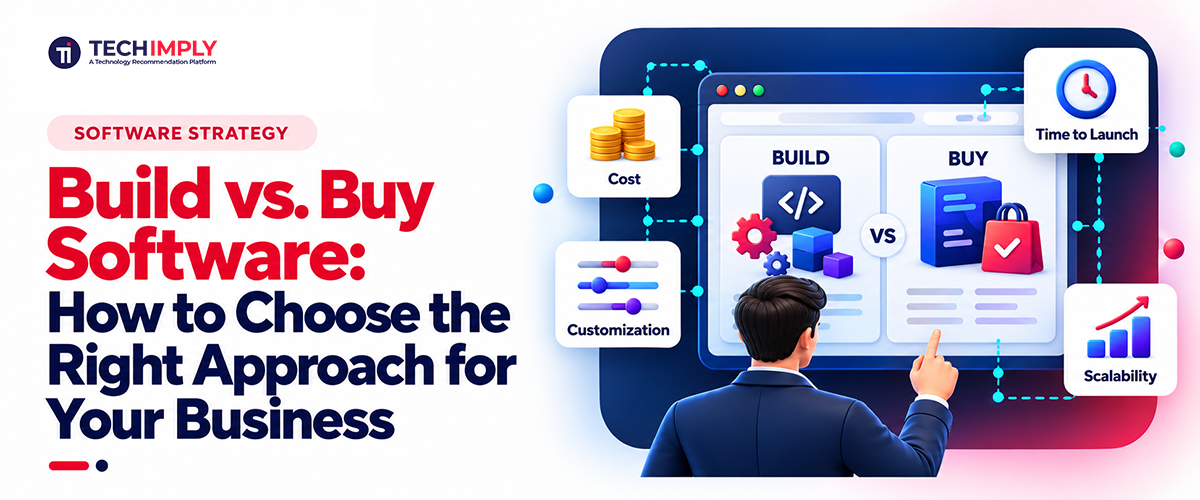
Every growing company reaches the same fork. A process outgrows its spreadsheet, a new product line needs a system, or the current tool starts slowing sales down. Leadership then has to decide whether to build or buy software.
It is a business decision about money, speed and control. It sets your spend in year one and year five, your launch date, and who controls your roadmap.
The Hygge Software team sees this moment often. Companies come to us asking for custom development. Before any estimate, we check whether building is the right call. Sometimes the answer is a subscription and two integrations.
This guide shares the framework we use in those conversations.
Build vs. Buy Software: What the Decision Really Means
Build vs buy software is the choice between owning a system and renting a product someone else designs. Both paths can work. They differ in who controls features, data, pace of change and long-term cost.
In practice, Hygge Software rarely sees a pure choice between the two extremes. Many companies land on a hybrid: a proven platform at the core, with custom parts where the business is different.
What "Build" Means for a Business
Building means your company owns the software. You decide what goes on the roadmap and when. You own the data model, the integrations and the architecture choices.
This matters most when technology is part of the business model, such as a marketplace with its own pricing logic. Here the software is the product. Handing its roadmap to a vendor hands over part of the company's future.
The trade is responsibility. You fund the first version, and you keep funding updates, security and hosting for as long as the system runs.
What "Buy" Means for a Business
Buying means you subscribe to a SaaS product or license off-the-shelf software. The vendor builds, hosts, secures and updates it. You configure it and start working.
Launch takes days or weeks, the first-year budget is lower, and nobody on your team patches servers.
The limits show up later. You get the features the vendor decides to ship. Pricing changes follow the vendor's plans. Your process has to fit the tool's model of how work should flow.
The Third Option: Buy, Integrate, and Extend
The hybrid model uses a ready platform for the common work and adds custom parts around it. Typical additions are integrations with internal systems, extra modules, customer portals, or a new interface on top of the vendor's API.
This path often gives the best ratio of cost to control. Billing, authentication and email stay with proven services. Your team spends its budget on the part that makes your company different.
Hygge Software builds products from scratch and also extends the tools a company already runs.
Custom Software vs. Off-the-Shelf: The Business Trade-Offs
The custom software vs off the shelf software comparison works best through business metrics. Look at time to market, total cost, flexibility, scale and operational efficiency.
Upfront Investment vs. Long-Term Cost
Custom software needs a large investment before it delivers value. Design, development, and testing all happen before launch.
Off-the-shelf software starts cheap and grows. Every new user adds a seat fee, advanced features sit in higher tiers, and integrations need paid connectors.
Over three to five years, the two cost curves can cross. The point where they cross depends on your team size, growth rate and how much of the product you use.
Speed to Market vs. Strategic Fit
A ready product wins when the business needs results this quarter.
Speed stops being the main factor once the tool shapes how you work. Typical signs are deals lost because the tool cannot model your pricing. Another is a support team using three screens for one ticket.
Flexibility and Control
With custom software, you control the features, the data structure, the release schedule and every integration. A change request goes to your own backlog.
With a vendor product, you configure inside the vendor's limits. A change request joins a public feature board with thousands of other requests.
Scalability and Future Growth
Scale means more users, data, regions and business lines. Custom architecture follows the growth plan you already have.
A SaaS product scales well inside its own design. Problems start when growth runs outside it. Examples are a market with new tax rules or data volumes the plan caps.
Vendor Lock-In and Software Ownership
Vendor lock-in is the cost and effort of leaving a product once your business depends on it. It builds up through pricing tiers, the vendor's roadmap, API limits, contract terms and data export rules.
Five questions to ask any vendor before you sign:
- Can we export all our data in a standard format at any time?
- What API rate limits apply to our plan, and what happens when we reach them?
- How much notice do we get before price or plan changes?
- Which features on our plan are scheduled for retirement?
- Who owns the custom configuration and workflows we create?
Custom software removes most of this risk when the contract gives you the source code.
The Real Cost of Build vs. Buy Software
The real cost is the total cost of ownership over several years. It includes everything your company pays to run, change and eventually replace the system. A development quote and a monthly subscription show only the entry price.
Costs Businesses Often Miss When They Build
Maintenance and updates. Frameworks, libraries and cloud services change every year, and the code has to keep up.
Security and compliance. Access reviews, penetration tests and audit evidence become your job.
Infrastructure and monitoring. Hosting, backups, logs and alerts grow with usage.
Product ownership. A custom system needs a person who decides what changes next. Without one, the backlog stalls.
Costs Businesses Often Miss When They Buy
Price growth. Subscription prices and tier limits change, and your plan changes with them.
Extra licenses and paid modules. New hires, contractors and partner accounts add seats. Key features often sit in a higher plan.
Integrations. Connecting the product to your CRM, ERP or data warehouse can need paid connectors or custom work.
Migration and switching costs. Moving data in is easy. Moving it out, retraining the team and rebuilding workflows costs far more.
When Does Building Custom Software Make Business Sense?
Building makes sense when the software creates value a subscription cannot give you. Knowing when to build custom software comes down to a few repeatable business situations.
Hygge Software helps companies test these situations against their processes, integrations, growth plans and long-term cost before any development starts.
Your Workflow Is a Competitive Advantage
Clients may choose you for the way you work. Custom software protects that advantage and makes it repeatable.
Case: IntellicAIr, healthcare staffing marketplace
Problem: The founder wanted anonymous, two-step sealed bidding at the core of the product. No third-party service offered this mechanism.
Solution: Hygge built the bidding engine as its own component and assembled the marketplace around it, with separate onboarding for facilities, agencies and nurses.
Result: Bids stay hidden until the round closes, so facilities compare offers on price and fit. Active development took around six months.
Off-the-Shelf Tools Create Too Many Workarounds
Workarounds are the clearest sign. Your team exports data into spreadsheets and retypes orders between systems. Each workaround costs hours every week and adds errors.
You Need Deep or Complex Integrations
Some systems have to talk to an ERP, a CRM, internal databases or physical hardware. When those connections carry the business, a custom layer gives you control over timing, error handling and data format.
Your Business Needs More Control Over Data and Security
Regulated data and strict client contracts often need specific hosting, access rules and audit trails. Custom software lets you decide where data lives and who can reach it.
SaaS Costs Increase Faster Than Business Value
Watch the ratio between the subscription bill and the value the tool brings. When seats and add-ons grow faster than revenue from the process, the tool is taxing your growth.
When Buying Off-the-Shelf Software Is the Better Decision
Buying is the stronger choice for standard business tasks. If the process works the same way in most companies, a mature product already covers it well.
The process is standard. Payroll, accounting, email, HR records and basic CRM follow well-known rules. Proven products already handle them for thousands of companies.
You need results fast. A launch deadline this quarter favors a tool you can configure in weeks.
Technology is outside your competitive edge. If customers choose you for service, location or expertise, spend your budget there.
You lack a team to own a system. Custom software needs long-term ownership. Without it, a ready product is the safer path.
Build vs. Buy Software Pros and Cons
The build vs buy software pros and cons below summarize the trade-offs. Read this off the shelf vs custom software table row by row with your finance lead.
|
Criterion |
Build (custom software) |
Buy (off-the-shelf software) |
|
Upfront cost |
High |
Low |
|
Long-term cost |
Predictable, mostly maintenance |
Grows with seats, tiers and add-ons |
|
Time to launch |
Months |
Days to weeks |
|
Fit to your process |
Exact |
Partial, the process adapts |
|
Control of roadmap |
Full |
Vendor decides |
|
Data ownership |
Full |
Depends on contract and export tools |
|
Integrations |
Designed around your systems |
Limited to vendor APIs and connectors |
|
Maintenance |
Your responsibility |
Vendor's responsibility |
|
Vendor lock-in risk |
Low |
Medium to high |
|
Competitive differentiation |
High |
Low, competitors can buy the same tool |
A Build vs. Buy Decision Framework for Business Leaders
The build vs buy decision software leaders face gets easier with these questions. Score each one with your finance and operations leads.
Is the Software Core to Your Competitive Advantage?
Would customers notice if you used your competitors' tool? If the system shapes the product, price or customer experience, lean toward building.
How Much of Your Workflow Can Existing Software Cover?
List your critical process steps and test the best products against them. If a product covers most steps without workarounds, buy it. If key steps stay manual, the gap grows with the company.
What Is the Three-to-Five-Year TCO?
Model both options over the full period, including seats, tiers, integrations, maintenance, hosting and internal time. Then compare what each option lets the business do.
How Quickly Does the Business Need Results?
Match urgency against realistic timelines. A hybrid often solves this: buy now for speed, and build the differentiating part in parallel.
Do You Have the Resources to Own the Software Long Term?
Custom software needs a product owner, a change budget and a reliable engineering team. Plan for them before the first release.
Build, Buy, or Hybrid? A Simple Decision Matrix
Use this matrix for a first read on your software build vs buy question.
|
Factor |
Build |
Buy |
Hybrid |
|
Time to market |
Slowest |
Fastest |
Medium |
|
Initial investment |
High |
Low |
Medium |
|
Ownership |
Full |
Vendor |
Shared: core rented, extensions owned |
|
Scalability |
Designed for your plan |
Limited by product design |
Core scales with vendor, extensions with you |
|
Customization |
Full |
Configuration only |
High in custom parts |
|
Integrations |
Built to your systems |
Vendor connectors |
Custom integration layer |
|
Maintenance |
Your team or partner |
Vendor |
Split |
|
Competitive differentiation |
High |
Low |
High where it matters |
How Hygge Software Approaches Build vs. Buy Decisions
Hygge Software starts every conversation with the business problem. A recommendation comes after the team understands the process, the systems and the economics.
- Discovery. We map the current workflow, the people involved and where time and money leak.
- Architecture assessment. We review the existing systems, their APIs and their limits.
- Requirements analysis. We separate what the business needs now from what it needs in two years.
- TCO comparison. We model build, buy and hybrid options over three to five years.
- Recommendation. The client gets a written answer with scope and an exact price for the path we recommend.
Hygge often recommends the hybrid path. On BoardsOnline, subscriptions run through Stripe and moderation uses an integrated service. Custom work went into the networking layer, job flow and country labor codes.
On Country Navigator, enterprise single sign-on moved onto Keycloak, and a manual per-client setup became one configuration. Custom work went into the rebuilt platform and an AI assistant.
"A missing feature is usually solved with an integration. The signal for custom development comes later, when the team shapes its work around the tool's limits. You see extra spreadsheets, manual re-entry and a sales process bent to fit a pricing tier. At that point the tool already costs the business growth. A custom system then has a clear number to beat."
Yevhenii Sukhov, CTO and Co-Founder, Hygge Software
Final Takeaway: Choose the Model That Creates More Business Value
The best answer to build or buy software is the one with the strongest business case. Build when the system carries your competitive edge. Buy when the task is standard and speed matters. Combine both when a proven platform covers the common work and your advantage sits on top.
Judge every option by return on investment, strategic importance, speed, risk and room to scale. Revisit the decision as the company grows.