
Any business, whether small or big, is operated on financial discipline. Your sales can be performing well, but when it comes to delay in payments, incorrect matching of invoices or the breakdown of relationship with the vendor, then your finances can soon get out of hand.

Looking for Accounts Payable Software?
Check out Techimply's the best Accounts Payable Software in India for your business.
Here the importance of a well run Accounts Payable (AP) function comes in. Quite on the contrary, AP is not a back-office activity as its direct contribution is to safeguard cash flow, enhance accuracy, and stabilize operations. Knowledge of the Benefits of Accounts Payable assists businesses to adopt proactive financial management as opposed to reactive payment of bills.
Definition Of Payable
The fundamentals need to be tackled before we plunge into the particular department. Payable is just a word that indicates that one has to pay something. In financial or legal sense, it is a legally binding role to give up assets or services to another party.
Definition Of Accounts Payable(AP)
So, what is accounts payable? Accounts Payable is the organized procedure through which a business organization follows, administers, grants, and remits its pending debts to its suppliers. Financial definition The accounts payable definition is comprised of the total amount that a company owes to its suppliers at a certain moment in time. In the accounting field, accounts payable (AP) takes care of the records that the liability is recorded and the payments are made at the right time and the records should be ready to be audited.
The Role Of Accounts Payable (AP) In Streamlining Business Finances
The primary accounts payable work is far more than just writing checks. The AP function is the gatekeeper of a company’s outflows, and its meticulous management is critical for operational health.
1. Invoice Capture And Verification
When an invoice is received, then the AP process starts. Regardless of the format of the invoices, they should be recorded and matched with purchase orders and delivery receipts. This action will avoid overpayments, invoices that are duplicated, and billing errors before they affect your books.
2. Invoice Approval
After verification, invoices pass through approval process. Well defined approval lines will see authorization of spending by the appropriate individuals and internal control mechanisms will be maintained without creating unnecessary delays.
3. Payment Authorization And Execution
After approval, AP schedules payments based on agreed terms. This stage of the accounts payable payment process ensures vendors are paid accurately and on time, while the business retains control over outgoing cash.
4. Record Keeping And Reconciliation
Proper record keeping enables the finance departments to balance invoices, payments and bank records. This minimizes variances and allows the end of month and end of year closing without reservations.
5. Vendor Management
AP is one of the important suppliers touchpoints. Timely payments and effective communication enhances trust between the vendor, increases the bargaining power and minimizes the supply chain interruptions.
6. Cash Flow Management
AP assists in the balance of outgoing cash and the incoming income through scheduling payments. Companies are able to enjoy the early payment discount or even payment terms when deemed necessary without fear of being slapped with these penalties.
7. Expense Tracking And Reporting
The AP data is fed into the financial reports providing an insight into the patterns of spending. This aids in budgeting, predicting, as well as making sound decisions at any level.
Key Job Roles And Responsibilities In Accounts Payable: From Clerks To AP Specialists
1. Accounts Payable Clerk/Assistant
1.1 Key Responsibilities:
- Entering invoices into the system
- Matching invoices with purchase orders
- Preparing basic payment batches
1.2 Required Skills:
- Attention to detail
- Basic accounting knowledge
- Familiarity with invoice processing tools
2. Accounts Payable Specialist/Coordinator
2.1 Key Responsibilities:
- Managing end-to-end invoice workflows
- Resolving vendor queries
- Supporting audits and reconciliations
2.2 Required Skills:
- Strong analytical abilities
- Knowledge of compliance standards
- Experience with AP software and spreadsheets
3. Accounts Payable Lead/Senior Specialist
3.1 Key Responsibilities:
- Overseeing complex transactions
- Reviewing approvals and escalations
- Mentoring junior AP staff
3.2 Required Skills:
- Advanced accounting expertise
- Problem-solving skills
- Process optimization experience
4. Accounts Payable Manager/Supervisor
4.1 Key Responsibilities:
- Setting AP policies and controls
- Managing AP teams and performance
- Aligning AP strategy with business goals
4.2 Required Skills:
- Leadership and communication
- Financial planning insight
- Risk management and compliance knowledge
Benefits Of Efficient Accounts Payable(AP)
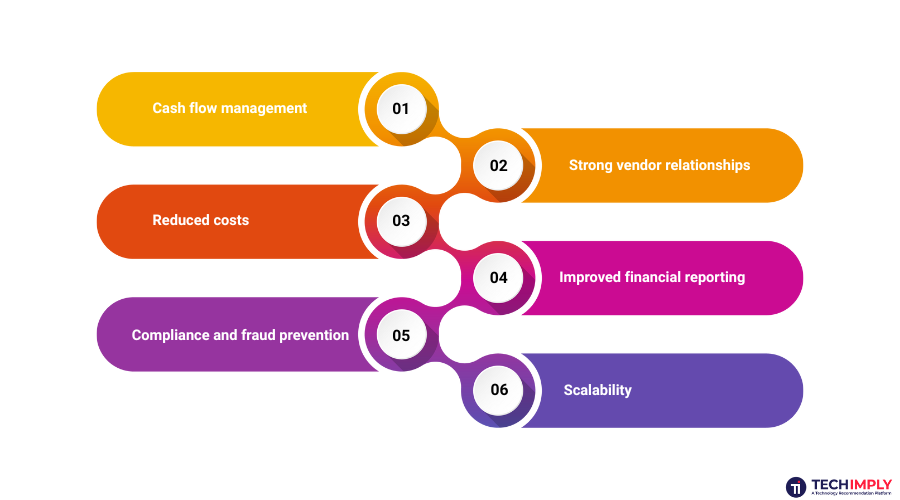
Investing in a high-performing AP function yields immediate and long-term returns. These accounts payable benefits go far beyond simple cost management.
-
Cash Flow Management
AP efficiency enables business to make payments at the right time without experiencing cash crunch and fulfilling the obligations. This stability is critical to financial stability.
-
Strong Vendor Relationships
Dependable payments are a source of trust. When the processes of AP are transparent, it is more likely that the vendors will give flexible terms and priority service.
-
Reduced Costs
The automation and the presence of standardized workflow mean that manual mistakes, late charges, and double payments are prevented directly reducing operational costs.
-
Improved Financial Reporting
Proper AP records will guarantee proper reflection of liabilities which enhances balance sheets and income statements. This transparency helps in improved decision making.
-
Compliance And Fraud Prevention
Approval workflows and audit trails are some of the controls that can reduce the risk of fraud and assist in regulatory compliance.

Do You Know?
Analysts have approximated that the cost of manually processing invoices can range between 10 to 25 dollars per invoice to the company. AP systems are entirely automated and can reduce this expense by up to 80 percent or higher, which illustrates the enormous payoff of the digital transformation in the given field.
-
Scalability
As transaction volumes grow, efficient AP systems adapt without increasing overhead, supporting long-term expansion. These are core accounts payable benefits that impact the entire organization.
Impact Of AP on Cash Flow
1. Increase In Accounts Payable
When a company increases its AP balance (by paying its suppliers later, within the terms), it is essentially holding onto its cash for longer. This is an increase in cash flow from operations for the period. While beneficial in the short term, this must be managed responsibly to maintain vendor trust.
2. Decrease In Accounts Payable
When a company decreases its AP balance (by paying its suppliers), it is a cash outflow. While this reduces the liability, it decreases the available cash on the balance sheet. Strategic AP management involves finding the sweet spot: paying just on time to maximize cash retention while preserving discounts and vendor goodwill.
How Technology Is Transforming Accounts Payable?
The present-day accounts payable software is transforming the functionality of finance departments. With the help of automation tools, invoice capture, invoice approval routing, and invoice payment schedules are now mostly automated with a minimum of human input. ERP assists in recognizing anomalies using artificial intelligence as well as offering real-time information of liabilities and spending through dashboards. This has made account payable work more strategic, accurate and faster.
Pro Tip:
When evaluating new accounts payable programs, look for systems that offer "straight-through processing." This means a purchase order-backed invoice, once scanned, can be approved and paid without a single human touch, reserving your staff’s time only for complex exception handling.
Practical Applications Of AP Payment Process: Real-World Scenarios And Examples
1. Retail Business – Managing Seasonal Vendor Invoices
Due to the festive seasons, a retail enterprise tends to have peaks of invoices. A good AP system will facilitate bulk processing in minimal time, and will keep cash flow up to date with the suppliers and will retain the control of seasonal cash flow changes.
2. Manufacturing Company – Handling Recurring Utility And Raw Material Bills
Manufacturers deal with predictable yet high-value expenses. AP ensures recurring utility bills and raw material payments are scheduled accurately and recorded correctly, supporting cost analysis and profitability reviews. These payments may also be reflected as trade expenses in trading account or profit and loss account, offering clarity on operational costs.
Conclusion
Accounts Payable is not merely about paying the bills anymore- it is a strategic financial role, which promotes cash flow, compliance, relationships with vendors and long-term development. AP when effectively handled, will be transformed into financial control levers. The Business can get the complete Benefits of Accounts Payable by investing in a structured process and modern tools that transform the ordinary payments into a platform of smarter and more adaptable financial management.