
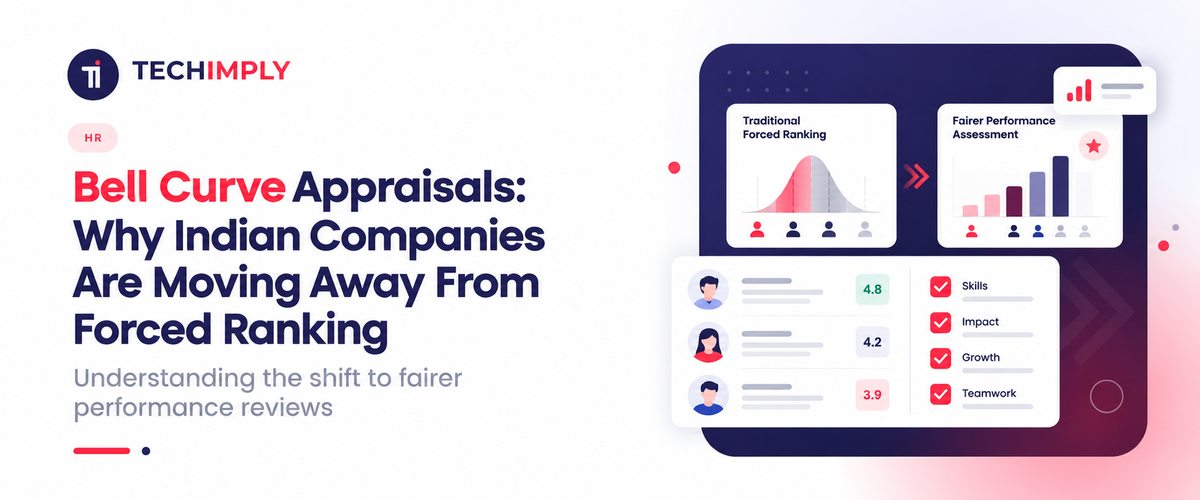
Businesses in India are eliminating the use of outdated forced ranking systems, or Bell Curve performance reviews, to use more adaptive, continuous systems. While the model was once adopted to adhere to a strict normal distribution among employees that is, putting a specific percentage of people into the top, average, and low-performing categories- today it is considered outdated for modern groups of people because it causes unnecessary reduction in employees’ creativity, loss of trust, and lack of employee satisfaction. It forces managers to classify talented people as good or average just to meet a predetermined quota. Thanks to the new trends in business, such as teams becoming cross-functional and employees becoming more expensive due to a talent war, many companies in India have been switching to more flexible systems that allow for continuous performance feedback.
What is a Bell Curve Appraisal in Performance Management?
The bell curve process became entrenched in the Indian corporate sector in the early 2000s because of the phenomenal growth of the information technology sector along with the BFSI (Banking, Financial Services, and Insurance) and manufacturing sectors. The system was indispensable for large firms as they could ensure uniform evaluations throughout their workforce of employee assistance and, at the same time, regulate their limited bonus funds. Unfortunately, the system not only became responsible for massive stress in the process of employee appraisal but also created conditions for a large number of employees to be branded as such regardless of their high performance simply to ensure compliance with the statistical requirements.
In recent years, the Indian market has experienced a radical shift towards moving away from the introduction of inflexible employee evaluation systems. The leading information technology firms and many advanced startups have abandoned or significantly relaxed the bell curve principle and introduced various continuous feedback systems, as well as introduced OKRs (Objectives and Key Results) and a performance appraisal system based on objective goal-setting. Even though some of the old-fashioned segments of the Indian economy have retained the simplified
Did You Know?
Are you aware that the bell curve framework became internationally known in the 1980s due to its usage by Jack Welch, former chair and CEO of General Electric, who named it Vitality Curve" or Rank and Yank. In compliance with Welch's system of evaluation, GE made the headlines for dismissing its 10% least productive employees every year. Nevertheless, almost three decades after, GE renounced the use of the bell curve after it recognized that enforcing a mathematical scheme onto people's collaboration impacted their cooperation negatively, initiated a lot of internal politics, and led top employees to leave the organization as they were not willing to compete with their colleagues.
Why are Indian Companies Rethinking How They Rate Performance?
- Mandatory rankings are wrong in terms of team cooperation: One of the biggest pitfalls of traditional approaches to evaluation, like the bell curve, was the requirement that high-performing teams of professionals belong to predefined mathematical categories. In practice, managers accepted that an exemplary employee had to be considered inefficient simply because the format required 10% of inefficient workers within the team. Such approaches set the tone for internal rivalry among team members, lost their trust, and harmed team collaboration.
- Transition to Regular Feedback: A delay of 12 months in providing customer feedback for employees can be very slow in dynamic industries such as technology, fintech, and modern retail. Annual reviews are being replaced with quarterly OKR (Objectives and Key Results) sessions, milestones, and continuous feedback loops.
- Costly Attrition Factor: Losing valuable employees due to a frustrating performance evaluation process leads to a much greater cost for employers in India’s competitive IT and services market than training them. Modern HR leaders recognize that effective and constructive assessment is much better at retaining staff than harsh rating systems.
- Emergence of Remote and Hybrid Work Patterns: Hybrid working methods made visibility-based assessment obsolete. Under performative evaluation based on physical presence at work, it shouldn’t matter whether an employee does their contribution well or not.
How does forced Ranking actually work in Indian Workplaces?
In Indian workplaces, forced ranking is performed through a fixed mechanism of normalization undertaken during the yearly appraisal cycles when managers first assess their subordinates on paper, and then the actual process is initiated in room-bound calibration meetings with HR and business heads. During these meetings, the individual scoring of performance is set against departmental quotas, causing a forced distribution such as 15% top performers (Band 1), 70% key performers (Band 2), and 15% non-performers (Band 3). Even if the whole engineering or sales team exceeds all KPIs, managers have to cut down part of their teams to meet the mandatory HR curve.
The process and workings of these calibration meetings are fundamentally skewed towards the corporate environment, transparency, and management upliftment. Due to the limitation on the number of positions in the high-performing category, it becomes important for the managers to actively cheer for their preferred employees in these stack ranking battles, and hence the non-aggressive managers land up agreeing to the downgrading of their employees. Many of the employees being placed in the last 15 to 10% bracket do not have to wait long for the results to follow, as they get no variable pay, no raise in salary, and must enroll for a 30-day to 3-month-long Performance Improvement Plan (PIP). In the case of major information technology firms, banks, and production industries in India, PIP is understood as an official early indicator of resignation or layoff and is expected to ease the processes of workforce transition and budget the pay of employees.
The pressure in workplaces in India becomes high, and unwanted consequences arise as a result of this situation. Sharing knowledge becomes limited since helping a colleague may guarantee that you will lose your position to someone who will become your competitor. To make sure they stay safe, managers have started to hire employees who are supposed to get the lowest score and to give the most valuable projects to team members. While companies in India used the method for forced ranking for the creation of a meritocratic environment in their workplaces at first, it has transformed into a system where visibility has the same importance as actual productivity.
Why are Indian Companies moving away from Forced Ranking?
- Destruction of Teamwork: Forcing teammates to see each other as competitors for a few high ratings leads to the development of political games, withholding of information, and bad working conditions rather than useful cross-functional collaboration.
- Loss of Talented Employees: Strong engineers and project managers often leave their jobs when they are assigned average or below-average ratings even though their team already has enough above average ratings assigned.
- Demoralization of Strong Teams: In high-performing organizations where every employee works at a level above the target rate, the management needs to cut the results of some employees in order to comply with the requirement of denying a certain number of average ratings.
- Transition to Continuous and Agile Delivery: Yearly reviewing through stack ranking is too slow for Indian tech companies and for companies in the fintech and GCC industries where performance evaluation is done based on weekly sprints and real-time feedback.
- Rise of Hybrid and Remote Work Metrics: The adoption of hybrid work is based on the necessity of implementing outcome-based assessments, while the forced ranking technique largely depends on subjective judgment of managers, their visibility, and the political situation in the office during annual calibration meetings.
- High Costs of Employee Turnover: An experienced employee has to be replaced with a new one at a significantly higher cost than investing in training the existing workforce.
- Emphasis on Psychological Safety and Growth: Present-day HR practices put the focus on psychological safety, tailoring career plans to individuals, and development of new abilities instead of punishing employees.
How does Bell Curve Grading Affect Employee Morale and Retention?
- Erosion of Psychological Safety: Employees experience the constant fear of mandatory calibration meetings.
- Annoyance with Unjust Downgrading: High-performing employees from highly skilled teams are persistently placed at lower rating categories that jeopardize their confidence in management’s fairness.
- Toxic Competition within the Company: Since it is a zero-sum game, employees perceive their peers not as co-workers but as rivals.
- Discouraging for High Performers: Employees classified as Core performers in the medium bands learn that putting in extra effort won't affect their scores, since the top promotion slots are already filled, resulting in disengagement.
- Sacrificial Asset Dynamics: Companies start hiring low-level contemporary personnel only for the sake of receiving the required poor evaluations, creating swift turnover cycles that deplete management time and recruitment budget.
- Migration of Talent to More Flexible Companies: Companies implementing strict forced distribution lose employees to more advanced organizations that enable goal-oriented OKRs, continuous feedback, and easy-to-understand reward systems.
What Alternatives are Indian Companies Adopting Instead?
Indian firms have moved away from strict appraisal systems, replacing them with principles that outline the importance of change management, goal clarification, and outcome-based performance.
1. The OKR System
Thanks to lessons learned from the world's leading tech companies, some organizations operating in India, including Flipkart and Swiggy, have decided to use the OKR framework. According to the framework, rather than being subjected to annual reviews according to predefined criteria, employees set challenging goals every three months. Instead of comparing employees to one another, they are assessed based on their own results (e.g., on issues like income from sales or the delivery of goods).
2. Absolute Goals & Standards-Based Systems of Evaluation
Unlike forced ranking systems, where employees vie for limited first places, Absolute Evaluation solely assesses employees against previously established KPIs and benchmarks. Thanks to this form of evaluation, if an entire group achieves its objective, all its members will get top ratings and bonuses without any artificial quotas.
3. Continuous Feedback and Check-ins
Large enterprises in IT, such as Wipro and Infosys, have abandoned yearly evaluations of employees' skills in favor of regular discussions about their progress. Monthly or quarterly meetings between coaches and corporate employees now allow them to keep track of their progress in terms of professional skills and current projects, allowing the company to shape job conditions in real time.
4. 360-Degree Feedback & Multi-Rater Assessment
In order to avoid bias from supervisors and office politics, businesses collect input from peers, cross-functional coworkers, and subordinates. This gives organizations a comprehensive view of changes to an individual’s ability to work or lead, as well as the contributions made on an ongoing basis.
5. 9-Box Grid for Talent Management
When it comes to leadership and high-potential individuals, Enterprise HR teams prefer to use the matrix of the 9-box grid, with current performance against future potential being measured. This allows HR professionals to separate present achievements from the ability to be a leader in the future and provide suitable training plans without necessarily classifying an individual’s performance as poor.

Pro-tip
For a successful transition from forced ranking, HR management needs to train the line managers to engage themselves in continuous discussions with the employees rather than regarding performance as an annual obligation. Organizations should separate performance reviews from compensation discussions, allowing employees to concentrate on their career development instead of preserving their bonuses. It is important to establish clear and well-defined Key Performance Indicators (KPI) at the beginning of each quarter and use current HR software that would assist in real-time monitoring of the results. This approach avoids the risk of bias caused by individual managers, maintains accountability, and allows for rewarding only proficient workers without the necessity to switch to ungrounded measuring of employees’ performance.
Conclusion
Avoiding forced ranking allows Indian enterprises to create a positive, growth-oriented work environment. There is an improvement in employees’ morale due to the change in the way performance management is perceived, using continuous feedback and appropriate goal-setting instead of a strict bell-curve approach. In order to implement modern performance management methods, companies need an appropriate digital infrastructure.



.png "Ecommerce SEO Guide Best SEO Practice For Ecommerce Site")