In the business-to-business (B2B) world of acute competition, the line between standing still and achieving scalability usually comes down to a single key factor: the ability to consistently attract and convert high-quality prospects. It is not only a marketing job to know how to generate Leads, but it's the blood and bones of your whole organization.

Looking for Lead Generation Tool & Software?
Check out Techimply's List of the Best Lead Generation Tools & Software for your business.
When your sales pipeline seems dry or an inconvenience, you are not alone. The art of effective lead generation is one of the aspects that many firms find difficult to master. This holistic manual will take apart the most effective B2B lead generation strategies; it will give you the practical tactics, practical real-world examples, and the tools you will require in order to develop a strong, predictable stream of new business leads.
What is Lead Generation in B2B?
Lead generation meaning refers to the process of identifying and cultivating interest from potential customers (or clients) in your company’s products or services. In the B2B context, a business lead is an organization or a representative of an organization that shows a strong potential to purchase your B2B offerings.
The primary difference when asking, "What is lead generation in b2b?" compared to B2C (Business-to-Consumer) is the complexity of the sale:
|
Feature |
B2B Lead Generation |
B2C Lead Generation |
|
Buyer |
An organization, often with a committee or multiple decision-makers. |
An individual consumer. |
|
Sales Cycle |
Longer, more complex, and often involving higher contract values. |
Shorter, simpler, and more transactional. |
|
Motivation |
Driven by logic, ROI, cost-saving, and operational efficiency. |
Driven by emotion, immediate need, and price. |
The goal of B2B lead generation is not just to collect contact information but to identify and qualify companies that fit your Ideal Customer Profile (ICP), ensuring your sales team focuses only on high-value opportunities.

Do You Know?
Organic search leads have a 14.6% close rate, compared to 1.7% for outbound leads. Prioritizing SEO dramatically improves the quality of your incoming leads.
Why Do You Need Lead Generation?
Without a steady flow of qualified business leads, your company is constantly fighting for survival rather than focusing on growth and innovation.
Lead generation is crucial because it directly fuels your revenue engine. A mature, well-documented lead generation process is statistically proven to result in significantly higher revenue. Companies that master this process see, on average, a 133% greater revenue growth than those who don't.
It ensures:
- Pipeline Predictability: You can accurately forecast sales and revenue.
- Lower Customer Acquisition Cost (CAC): Strategic methods are often more cost-effective than scattergun advertising.
- Sustainable Growth: A continuous process ensures you are always engaging new markets and customers.
Looking for Event Marketing Software?
Check out Techimply's List of the Best Event Marketing Software for your business.
Top Effective B2B Lead Generation Strategies That Work
Effective B2B lead generation strategies combine attracting prospects who seek you out (Inbound) with proactive outreach to targeted accounts (Outbound). The best systems integrate both.
I. Inbound Strategies (Attracting Qualified Business Leads)
The core principle of generating inbound leads is providing value first, which naturally attracts your ideal prospects. This is how to generate leads for inbound strategies.
1. Targeted Content Marketing
Content is the magnet that pulls potential b2b leads to your digital doorstep. To turn visitors into qualified prospects, your content must address their most pressing professional pain points.
-
Actionable Content: Create in-depth guides, white papers, or industry reports. For example, a B2B SaaS company might offer a free, gated "State of AI in Marketing" report. The gate, a form requesting contact info, is a direct means of lead creation.
-
Value Exchange: This content acts as a lead magnet—an item of value offered in exchange for a prospect's contact information. This is a foundational way to do lead generation.
-
Real-World Example: A cybersecurity firm publishes an annual "Threat Landscape" report, requiring an email address for download. This generates thousands of qualified leads, primarily security directors and CIOs, who are eager for the specialized, timely information.
2. Advanced B2B Search Engine Optimization (SEO)
Being visible when a prospect searches for a solution is non-negotiable. Advanced B2B Search Engine Optimization (SEO) goes beyond simple keyword inclusion.
-
Intent-Based Optimization: Focus on high-intent terms like "best ERP software for manufacturing" or "outsourced IT services pricing." These prospects are actively in the buying cycle.
-
Schema Markup & Rich Snippets: Implement technical SEO to make your valuable content stand out in search results, increasing click-through rates.
3. Strategic LinkedIn Marketing (Organic & Paid)
LinkedIn is the world's most critical platform for B2B engagement. It's where decision-makers go for professional insights.
-
Organic Thought Leadership: Consistently valuable content (analyses, industry predictions, case studies) that positions your executives as experts. This organically draws in prospects interested in your specific expertise.
-
Targeted Ads: Use LinkedIn's powerful demographic targeting to place specific offers (like a free demo or your newest e-book) directly in front of VPs of IT or C-suite executives at companies that fit your ICP.
4. Website Optimization & Conversion Funnels
Your website is the ultimate conversion tool. Every page must be designed to facilitate the lead creation process.
-
High-Impact Calls-to-Action (CTAs): Use clear, compelling CTAs above the fold, especially for your lead magnet.
-
A/B Testing: Continuously test different headlines, button colors, and form lengths to optimize your conversion rate. A small change, like simplifying a form from five fields to three, can sometimes generate 20% more leads.
Looking for a Website Optimization Tool?
Check out Techimply's List of the Best Website Optimization Tools for your business.
II. Outbound Strategies (Proactively Reaching Out to Businesses)
While inbound strategies attract leads, outbound strategies allow you to specifically target high-value accounts that may not yet be looking for a solution but would benefit greatly from your offering.
1. Personalized Email Marketing
Forget generic mass blasts. This strategy involves highly targeted, sequenced outreach.
-
Hyper-Personalization: Use sales intelligence data to reference a prospect's recent company news, job change, or specific pain point mentioned in a public forum. An email that opens with, "I saw your company recently expanded into the X market, which often brings the Y challenge," is far more effective than a generic template.
-
Multi-step Cadences: An effective outreach campaign involves multiple touchpoints (email, LinkedIn, sometimes a call) over several weeks, providing value in each step rather than just asking for a meeting. Operationalize intent insights by maintaining a structured B2B database of verified contacts - with standardized fields, clear ownership, and update cadences - to consistently target active buying committees.
2. Sales Intelligence & Intent Data
To effectively generate business leads today, you need more than just a company name. Sales intelligence provides context and buyer intent signals. What is Intent Data? This data tells you which companies are actively researching solutions like yours right now, based on their content consumption across the web.
3. Account-Based Marketing (ABM)
ABM is a highly focused approach where marketing and sales align to target a specific list of high-value accounts.
4. Strategic Partnerships & Referrals
Your network is one of the most powerful and often overlooked sources of lead generation.
-
Referral Programs: Formalize a program that rewards existing happy clients for sending new business your way.
-
Non-Competitive Partnerships: Partner with companies that serve the same target audience but offer complementary, non-competing services (e.g., a web design agency partnering with a digital marketing firm).
5. Event Marketing (In-Person & Virtual)
Events remain a highly effective channel to connect face-to-face (or screen-to-screen) with prospects.
-
Webinars and Virtual Summits: Use these as a massive lead creation opportunity. The registration process captures vital prospect data.
-
Follow-Up is Key: The real lead generation happens in the 48 hours following the event. A personalized email summarizing the key takeaway and offering a next step is crucial.
6. Smart Cold Calling
Cold calling is not dead, but it must be smart. It works best as one step in a wider, personalized outreach lead generation system.
-
Research First: Never cold call without thoroughly researching the company and the specific person you are calling. Your call must quickly reference their pain point to justify their time.
-
Goal: Appointment, Not Sale: The goal of the call is usually to schedule a brief, more detailed follow-up, not to close the sale on the spot.
Case Study Example: The ABM Approach
A company specializing in b2b lead generation services for the finance industry wanted to target the top 50 banks in North America. They didn't just send generic emails. Instead, they identified key decision-makers at each bank and created ultra-specific, high-value content (e.g., a custom landing page or a printed financial trends report) tailored to the unique regulatory challenges of that specific bank. The result was not just more leads but fewer, higher-quality conversations with the right people, leading to a major contract win. This is a prime example of effective b2b lead generation strategies in action.
Pro Tip
Integrating intent data into your outbound strategy means your team is calling companies that are already warming up, significantly shortening the sales cycle. ai sdr can automate this process, helping prioritize high-value leads and initiate outreach when they’re most likely to convert.
Effective B2B Lead Generation Process
A successful lead generation system follows a structured, repeatable methodology.
1. Understand Your Target Market
You cannot effectively generate business leads until you know who you are selling to.
-
Define Your ICP: Create a detailed profile of the perfect company (industry, size, revenue, location).
-
Develop Buyer Personas: Create semi-fictional representations of the key decision-makers within those companies (job title, goals, pain points, daily challenges).
2. Connect with Your Prospects
This is where your inbound and outbound strategies are executed. The goal is to get their attention and offer your lead magnet or initial value proposition.
3. Qualify High-Quality Leads
Not all leads are created equal. You must have a system to score and qualify them.
-
MQL vs. SQL: A Marketing Qualified Lead (MQL) has shown interest (e.g., downloaded a report), but a Sales Qualified Lead (SQL) has explicitly indicated readiness to buy (e.g, requested a demo). The latter is an urgent priority.
-
Lead Scoring: Assign points to leads based on actions (e.g., +5 for opening an email, +20 for requesting a pricing guide, -10 for being in the wrong industry). Once they hit a certain score, they are passed to sales.
4. Close the Deal
Once qualified, the SQ L moves fully into the sales cycle for final closing. Marketing’s role here is to provide the sales team with the necessary collateral (case studies, data sheets) to support the final stages of the negotiation.
Looking for Account-Based Marketing Software?
Check out Techimply's List of the Best Account-Based Marketing Software for your business.
Top B2B Lead Generation Tools
No lead generation system is complete without the right technology to automate, track, and scale your efforts. The B2B lead generation service market size was valued at USD 7 billion in 2024 and is projected to reach USD 15 billion by 2032, growing at a CAGR of 8% during the forecasted period of 2026 to 2032.
1. Pipedrive
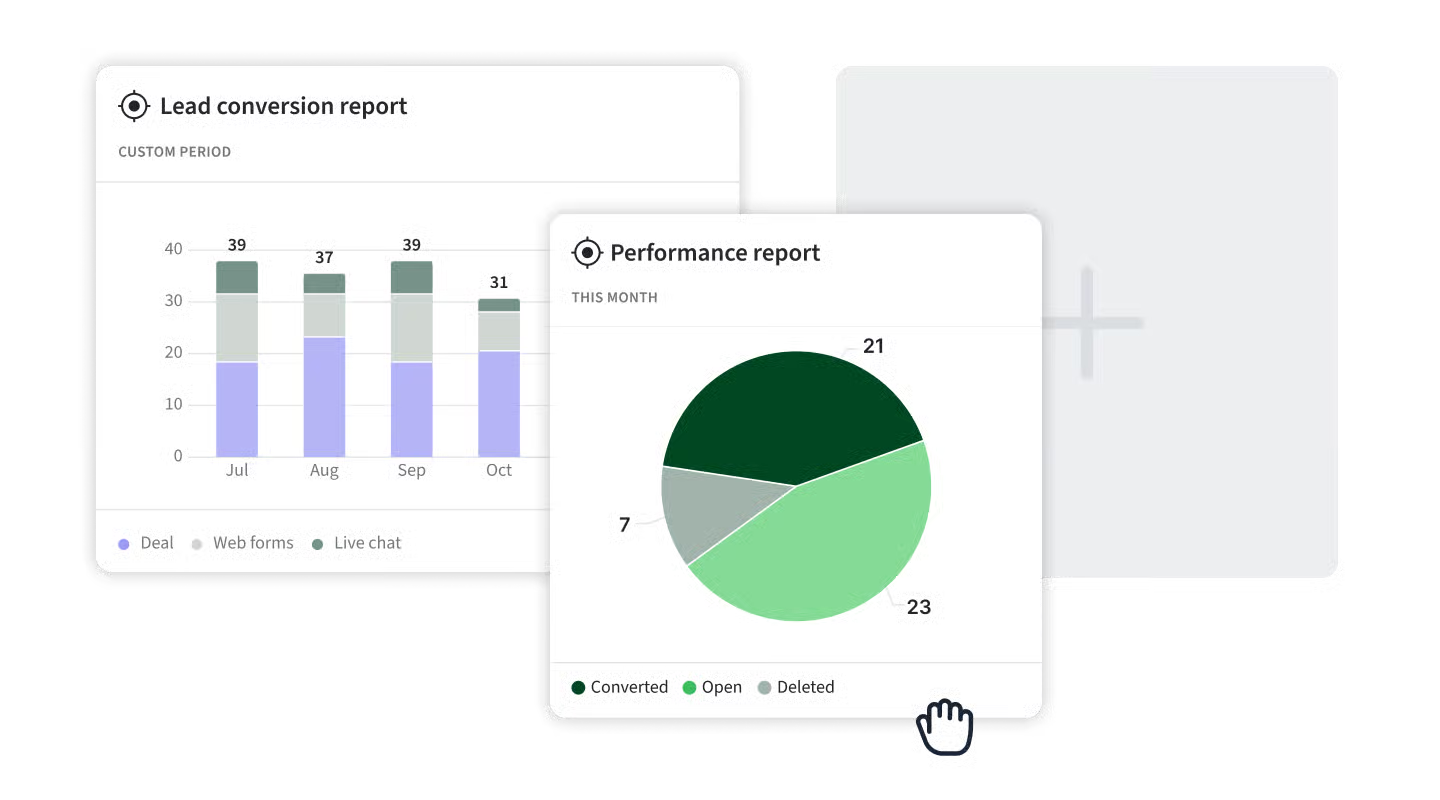
An excellent sales-focused CRM designed to help sales teams track deals and move leads efficiently through the pipeline, making sure no business lead falls through the cracks.
Features:
- Visual sales pipeline with drag-and-drop interface
- Email integration with tracking and templates
- Workflow automation for repetitive tasks
- Advanced reporting and forecasting tools
- 400+ third-party integrations
Pros:
- Intuitive and user-friendly interface
- Strong lead and deal management
- Mobile app with sales tools
Cons:
- Limited marketing automation
- No free plan
- Some features are locked behind higher tiers
Pricing: Starts at ₹2127.47/month per user
2. Leadpages
A specialized tool for creating high-converting landing pages and pop-ups quickly. This is critical for maximizing the success of your lead creation efforts.
Features:
- Drag-and-drop landing page builder
- AI-powered content and SEO suggestions
- Built-in conversion guidance (Leadmeter)
- Unlimited landing pages and pop-ups
- CRM and email marketing integrations
Pros:
- Fast page creation without coding
- High-converting templates
- Seamless third-party integrations
Cons:
- Limited design flexibility
- Mixed customer support reviews
- Can be expensive for small teams
Pricing: Starts at ₹4343.58/month
3. OptinMonster
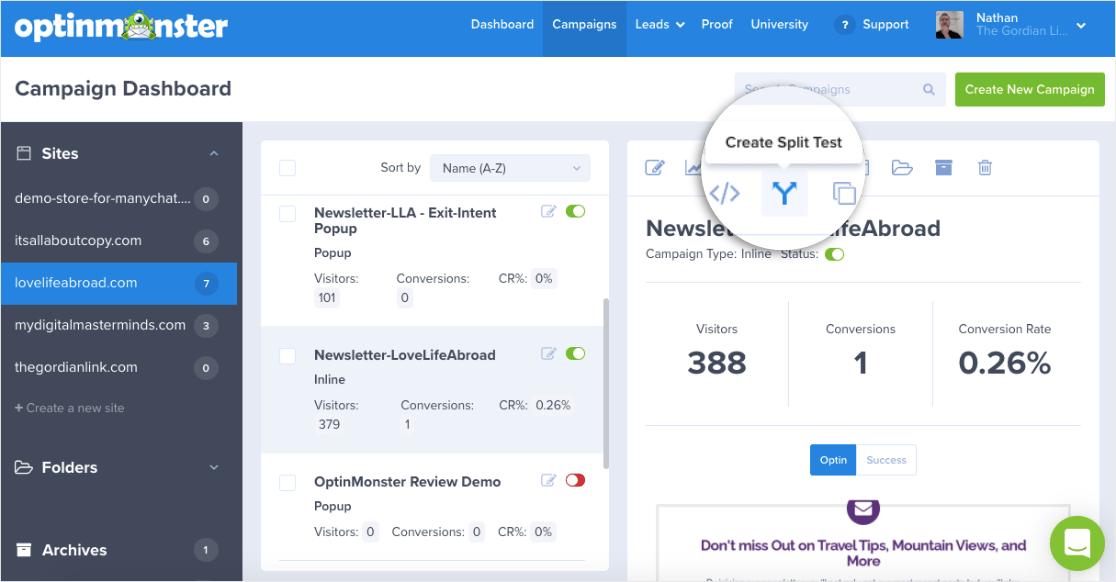
Highly effective for optimizing conversion rates on your existing website traffic through exit-intent pop-ups and targeted forms to capture leads.
Features:
- Exit-intent popups and lead capture forms
- A/B testing and conversion analytics
- Page-level targeting and behavior automation
- Drag-and-drop campaign builder
- Integration with major email platforms
Pros:
- Excellent for reducing bounce rate
- Highly customizable targeting rules
- Easy to implement on any website
Cons:
- No free plan
- Learning curve for advanced features
- Premium plans can be pricey
Pricing: Starts at ₹1241.02/month
4. HubSpot
A comprehensive CRM and marketing automation platform that excels at inbound marketing lead generation, managing contact data, lead scoring, and nurturing campaigns. It centralizes your entire lead generation process.
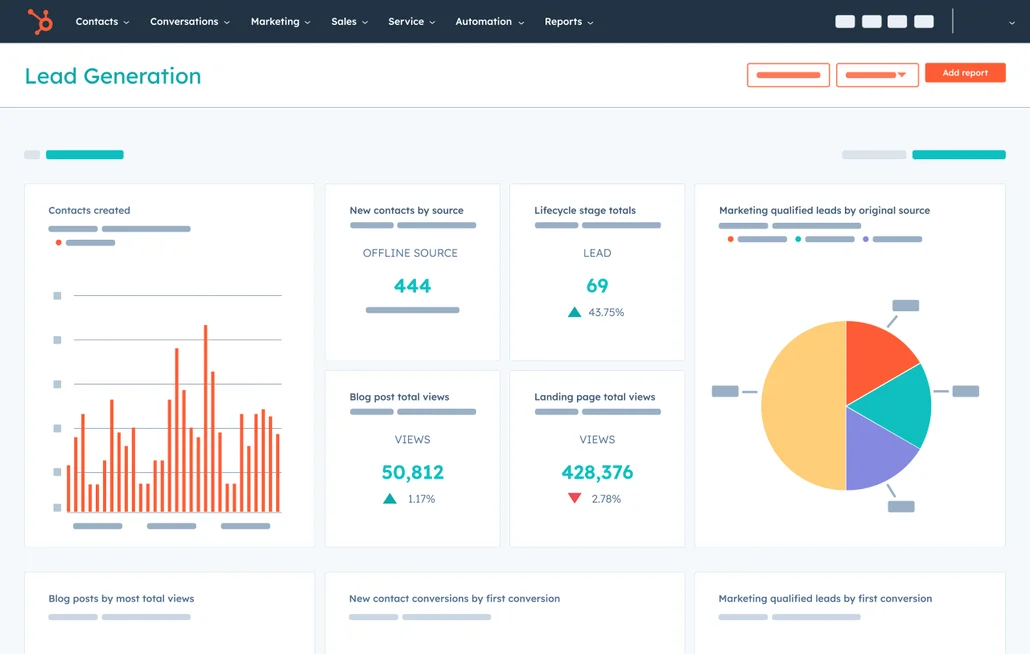
Features:
- CRM with lead tracking and segmentation
- Email marketing and automation tools
- Landing page and form builder
- Real-time analytics and reporting
- Integration with sales and service hubs
Pros:
- All-in-one marketing and CRM platform
- Scalable for growing businesses
- Strong community and support
Cons:
- High cost for advanced features
- Annual contracts with limited flexibility
- CMS limitations for custom builds
Pricing: Starts at ₹74,200/month.
5. Linked Helper
Linked Helper is a LinkedIn automation and lead generation platform designed to help sales teams, marketers, recruiters, agencies, and businesses automate LinkedIn outreach. It enables users to build automated connection and messaging campaigns, follow up with prospects, collect and enrich lead data, and manage contacts through its built-in CRM. The platform also includes AI-powered features for lead qualification, personalized messaging, reply assistance, and comments. It supports LinkedIn, Sales Navigator, Recruiter, and Talent accounts, making it useful for businesses looking to scale B2B prospecting and social selling
- LinkedIn connection request automation
- Automated follow-up and messaging sequences
- AI-powered personalized messages
- AI-based ICP lead detection
- LinkedIn profile and company data scraping
- Email and phone number data enrichment
- Built-in CRM with tags and notes
- LinkedIn Sales Navigator support
- InMail automation
- Automated profile visits and follow-ups
- AI-generated LinkedIn comments
- Reply detection and automated campaign stopping
- CSV lead export
- Webhook and CRM integrations
- Smart daily limits and working-hour controls
- Proxy and account-safety features
- Multi-account workspace management
- LinkedIn event and group invitations
- Auto-accept and cancellation of connection requests
- AI reply assistant
- Comprehensive LinkedIn automation: Covers connection requests, messages, follow-ups, profile visits, engagement, and lead collection.
- AI-powered outreach: AI can personalize messages and help identify prospects that match a defined ICP.
- Lead enrichment: Can provide additional contact information such as emails, phone numbers, company information, and other profile data.
- Flexible campaign builder: Users can create multi-step outreach funnels with different actions and conditions.
- Built-in CRM: Helps organize LinkedIn contacts using tags, notes, filters, and campaign information.
- Multiple integrations: Supports tools such as HubSpot, Salesforce, Pipedrive, Zoho, Apollo, Google Sheets, and others.
- Free trial: Offers a 14-day trial with access to the full feature set.
- Useful for B2B sales: Particularly suitable for SDR teams, agencies, recruiters, and businesses using LinkedIn as a prospecting channel.
- LinkedIn-focused: The platform is primarily designed around LinkedIn outreach, so it may not be suitable as a complete multichannel lead-generation platform.
- Automation requires careful configuration: Users need to configure campaigns and limits properly to avoid overly aggressive outreach.
- Additional data costs: Email, phone, and other enrichment activities consume data credits, with additional credits available for purchase.
- One license per LinkedIn account: A license is intended for one LinkedIn account at a time.
- Some advanced capabilities are limited by plan: Standard users have restrictions on advanced actions, webhooks, and daily activity compared with Pro.
- Desktop-based automation: Linked Helper runs as desktop software, so users should consider their device/VPS and operating requirements when deploying it
Conclusion
Mastering how to generate leads is an ongoing, data-driven journey, not a destination. The most successful businesses treat lead generation as a science, constantly testing new approaches, measuring results, and refining their b2b lead generation strategies. By focusing on providing exceptional value, leveraging the right tools, and committing to a structured process, you can ensure a consistent, high-quality stream of b2b leads that guarantees long-term growth and success.