Application management plays a critical role in ensuring that businesses are competitive. What is Application Lifecycle Management is a question many organizations pose when trying to find a way to enhance efficiency, mitigate risk, and produce high-quality software.
In simple terms, Application Lifecycle Management (ALM) is a formalized state of managing the full life cycle of an application, beginning with the conception of an idea through to its end stage of being disposed of. The ALM full form is a term that is used to describe the Application Lifecycle Management and is the foundation of successful software delivery by integrating people and processes along with tools into a single strategy

Looking for Application Lifecycle Management software?
Check out Techimply's Best Application Lifecycle Management software for your business.
We are going to look at the five phases of ALM, disaggregate its advantages, explain why it is essential in the modern fast-paced digital economy, and answer such questions as how ALM is different from SDLC, what the most popular tools are, and why it has become so important in the business world.
What is Application Lifecycle Management (ALM)?
Application lifecycle management refers to the coordination of the software application at all phases, such as planning, development, testing, deployment, and maintenance. As opposed to conventional approaches, ALM transcends the code-writing process by fostering cooperation between business units, software developers, quality assurance, and operations. It combines project management, version control, testing, and release planning into a single process.
Imagine that ALM is the link between business needs and IT implementation, where software products are delivered to address their purpose without compromise or quality.
This is a very applicable discussion thread where the topic of Application Lifecycle Management is further expounded, and its significance is also discussed.
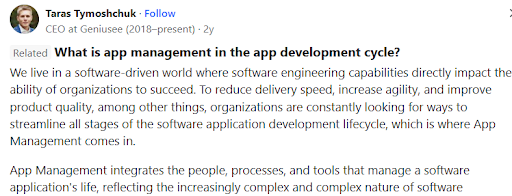
Reference Link: Quora
This thread offers useful information regarding ways in which businesses apply ALM in order to facilitate the development process and safeguard the long-term success of products.
What are the 5 Stages of ALM?
All successful applications follow an organized process until they reach end users and further develop even after implementation. The application lifecycle management process aims to take this journey step by step without neglecting the alignment of business goals, user requirements, and technical requirements along the way. In general, the ALM framework may be split into five key phases.
1. Defining Requirements
The identification and documentation of what the business and its users actually need is the first step of software lifecycle management. This covers functional requirements (what needs to be done by the application), technical requirements (how it needs to be built), and compliance requirements (what the application needs to adhere to). A documented set of requirements will form the basis of the whole project. Lack of this clarity leads to a drift of the application development life cycle very easily.
2. Development of the Product
After it is clear what is required, the actual cycle application enters the development stage. This phase involves architectural planning, coding, feature development, and system integration. With the practices of ALM, development teams can be confident that all features are directly related to business objectives and quality criteria.
Application lifecycle management tools enable developers, testers, and business teams to reside on the same platform as opposed to the traditional siloed development. This will ensure transparency, prevent duplication, and accelerate the process.
3. Testing and Quality Assurance
Creating an application is one thing, but making it functional is another thing. This is where ALM testing is important. This phase of area testing, starting with unit testing and integration testing, is to ensure that the software is designed to both technical and customer specifications. For optimal results, modern teams also rely on apm tools, which monitor application performance, detect errors, and provide real-time analytics to ensure smooth user experiences and quick bug resolution. Integrating apm tools into the testing process supports continuous quality improvement and helps optimize both functional and performance aspects of the software for end users.
Through integration of testing into the software life cycle process, defects can be detected and corrected in the initial stages, saving time and cost. A well-developed quality assurance system will result in a reliable, secure, and ready-to-use final product.
4. Deployment
After developing the application and testing is complete, it focuses on the rollout of the application. The deployment phase is concerned with the release of the software into the production environment, where it will be accessed by end users. This process is facilitated, coordinated, and risk-free by ALM.
Integrated release management enables teams to perform faster deployments with less downtime and disruption. Automated deployment pipelines are also supported by many current application lifecycle management tools, minimizing errors during manual deployment and accelerating delivery.
5. Continuous Maintenance and Improvement of the Product
Deployment is not the final stage of the journey—it becomes the start of a new cycle. To remain relevant, applications must be constantly monitored, updated, bug fixed, and enhanced in performance. This is completed last because the software is modified according to the business needs and expectations of the users.
Organizations can only guarantee that the long-term value of their applications is realized by ensuring that continuous improvement is integrated into the application lifecycle management process. It might be making its performance easy or coming up with new features, or just complying with new policies, but what it all boils down to is that it is continuous maintenance that will make the application efficient and competitive.

Did You Know?
Industry research claims that organizations that implement formal ALM systems can deploy much faster and have a substantial reduction in the number of post-release defects than those utilizing traditional development methods.
Benefits of Application Lifecycle Management
The right application lifecycle management tools help organizations to have real-time visibility of their projects, optimizing resource use and providing quality products at increased speeds. The application lifecycle management market is expected to grow to USD 6.58 billion by 2029 with a compound annual growth rate (CAGR) of 8.6% in the period.

1. Increased Visibility & Traceability
The provision of total visibility of all software life cycle stages is one of the most useful benefits of ALM. Stakeholders are able to follow progress in real time, from defining requirements through to deployment and ongoing maintenance. End-to-end traceability will ensure that nothing is missed and will simplify showing compliance with the internal policies and external regulations.
2. Improved Collaboration & Communication
New applications are not commonly developed in isolation. Application lifecycle management tools enable business analysts, application developers, testers, and operations teams to collaborate on a single platform. The organizational environment will experience the minimum amount of confusion, will experience the minimum amount of unnecessary duplication, and will experience a single environment where everyone will have a business purpose.
3. Higher Quality Products
Organizations can find and resolve defects earlier on by integrating quality checks at each of the application lifecycle management process stages. The proactive strategy is very effective in enhancing the credibility of the product and minimizing the chances of the occurrence of expensive mistakes during post-release. Because of this, businesses have provided software that not only performs but is also satisfactory to the customer.
4. Faster Deployments
The current day and age is very competitive in terms of time-to-market. ALM simplifies the stage application process through the coordination of development, testing, and release. Constant integration and automation make sure that updates and new features are deployed fast without affecting stability.
5. Enhanced Compliance
Healthcare, finance, and government industries are required to comply with high standards of compliance. ALM software lifecycle management keeps an auditable log of requirements, approvals, and test outcomes to ensure that organizations remain within the regulatory provisions and limit the risk of fines.
6. More Efficient Resource Utilization
Under ALM, the teams have higher visibility of resources, workload balancing, and productivity tracking. Application development life cycle management is more sustainable because organizations can deliver maximum output with minimal costs through the reduction of duplication of work and optimization of workflow.
7. Data-Driven Decision Making
The tools of the application lifecycle management record useful project data at each stage. These are able to help businesses determine the bottlenecks and the team performances to make the correct decisions that can enhance their present and future projects. The judgments reached are supported by concrete facts as opposed to suppositions.
8. Reduced Risk
The combination of all the elements of the software life cycle process reduces the risk factor of miscommunication, project delay, or quality failure. By having all of the requirements, testing, and compliance all operating under a single system, the organizations are able to see all of the problems that could occur even at an early stage and put in place remedial measures before they can become a problem.
Pro-tip
Select an ALM tool that can fit perfectly into your current project management and DevOps system. This makes the adoption easier and promotes more effective cooperation between teams.
Conclusion
What is Application Lifecycle Management is no longer a question—it is an important business practice. ALM allows applications to not only be developed to meet business requirements but also be flexible to meet changing user needs by combining requirements, development, testing, deployment, and maintenance. Cycle application and ALM practices will help businesses succeed in the long term by supporting better collaboration as well as faster releases.

.png "Top 5 Symptoms You Gravely Require New Hotel Management Software")