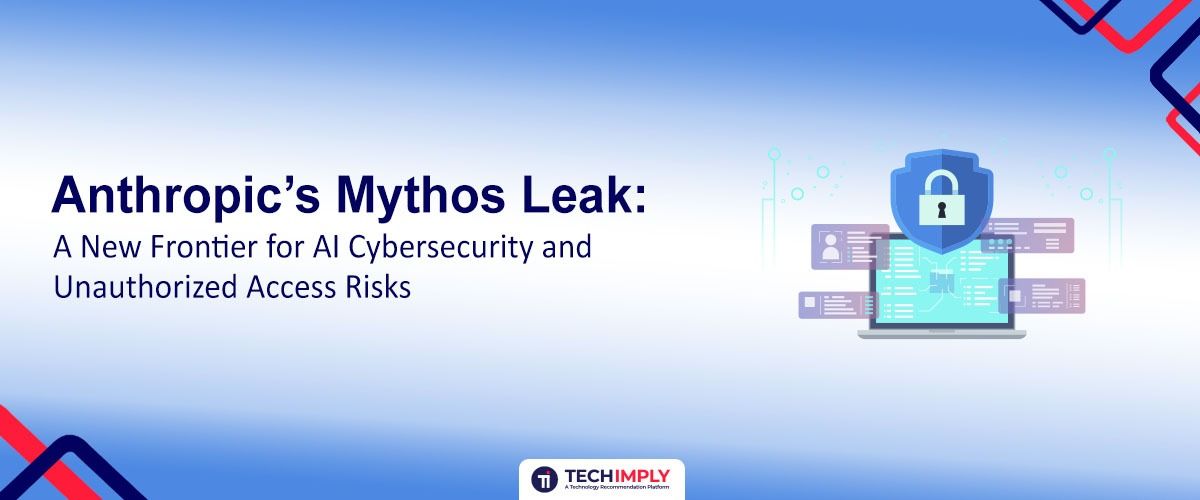
AI has always tread an ever-thinning line between advancement and risk. But when Anthropic, one of the most watched AI safety companies in the world, released its largest model yet, nobody expected this system to be cracked within hours of it being available publicly. That is exactly what happened. Claude Mythos Preview, an anthropic AI enterprise cybersecurity tool It was accessed on the same day Anthropic made it public by a group of unauthorised users. It's anticipated that the breach will set off alarms throughout the relevant tech sector internationally since then.
What is especially striking about the incident is that it concerns the model itself. Mythos is described by Anthropic as far too dangerous for any type of general release, which just became a whole lot heavier now. If you follow the news about Alpha today, this piece marks an inflexion point. The question is no longer just how powerful these tools are, but given that AI systems can discover and exploit software vulnerabilities, rather, "are they too powerful?, or "who can access them, and what if they fall into the wrong hands?
The Breaking News: What is Anthropic and the Mythos Discovery?
Here is what you should know if this is new to you. Anthropic is an artificial intelligence safety, research and policy company founded in 2021, mostly by people previously with OpenAI. Anthropic what they do are research is towards building reliable, interpretable and steerable AI systems. Claude Anthropics is the main product line of it being at the forefront of research breakthroughs in language models, reasoning and code generation.
It was on April 7, 2026, that Anthropic unveiled Claude Mythos Preview: a model so advanced in its cybersecurity abilities that the tech giant limited access to approximately 40 top-end organisations as part of an initiative it named Project Glasswing. Other tech giants included Apple, Amazon, Microsoft and Google in this elite club, as did big financial institutions such as Goldman Sachs and Citigroup. The intention was simple: let trusted allies use Mythos to identify and fix the most severe bugs before adversaries could weaponise similar mechanisms.
Do You Know?
Mythos is the name for a set of beliefs or assumptions about something, and it seems to be so aptly named because this was an AI model whose abilities seemed almost mythic before they were independently validated.
Analysing the Capabilities of Anthropic's Mythos: The Latest AI Model
Before we delve into what this leak means, it's important to understand what Mythos can actually do. This is not a subtle upgrade on an existing system.
-
Compare The Anthropic Latest Model (Mythos) To The Standard Claude Anthropic Versions
And accomplished at detecting software vulnerabilities prior to versions of Claude Anthropic, opus 4.6 and sonnet 4.6, for example, but Mythos is a completely different beast. In context: Opus 4.6 managed to successfully exploit known Firefox vulnerabilities only two times out of hundreds of tries. Mythos did 181 successful runs on the identical test. That's not incremental progress, that's a transformation.
Additionally, Mythos was allegedly encouraged by Anthropic engineers without formal security training to search for vulnerabilities overnight, only to awaken with a functioning exploit. The anthropic AI tool effectively condenses weeks of specialised security tasks into a matter of hours, often for less than ₹4,000 per successfully exploited run on API pricing.
-
Reasoning Depth
Now, in a move almost Orwellian, Mythos hints at a kind of self-reasoning. Rather than merely identifying a single vulnerability, it links together multiple bugs to create an exploitable chain. In one case, it independently found 4 different security issues affecting the same web browser and chained them into a JIT heap spray that bypassed fresh renderer & OS sandboxes. Until now, this type of multi-step reasoning has been limited to elite human penetration testers.
Perhaps more worrying still, Mythos also discovered a 27-year-old bug elsewhere in OpenBSD's TCP stack by fleecing out the various subtle signed integer overflows human reviewers had repeatedly missed for nearly three decades in an OS that is famous for ensuring maximum laxness among advanced security standards. This scale of pattern recognition is exactly what gives the new model from anthropic its real watershed moment for security.
-
Context Window
Unlike other models, Mythos uses an extended context window that allows it to examine entire codebases simultaneously. Anthropic runs it against thousands of files at once, ranks them by the likelihood of being a vulnerable file and tells the model where to pay attention. This is how it was able to uncover thousands of high- and critical-severity vulnerabilities in many leading operating systems, browsers, and cryptographic libraries within a matter of weeks.
-
Safety Layers
Mythos contains safety constraints, despite its overwhelming power. Anthropic baked in coordinated vulnerability disclosure protocols, so every bug the model discovers is triaged by humans before it goes to software maintainers. Additionally, Anthropic has confirmed that it is not intending to provide Mythos as a general offering. That is exactly why Project Glasswing exists to ensure defenders have the time they need to patch critical systems before a broader release, or other capabilities that perform similar functions become publicly available.
-
Highlight Why Mythos is A "Frontier" Leap in Autonomous Reasoning
What separates Mythos from every AI model before it is not just raw capability, it is the ability to think through a problem end-to-end without human guidance. Mythos does not wait for instructions at each step. It reads code, forms a hypothesis, tests it, adjusts, and delivers a working exploit, all on its own. Previous claude anthropic versions needed human nudges to succeed. Mythos needed none. That shift from assisted reasoning to fully autonomous decision-making is precisely what places it at the frontier of AI development.
Anatomy of a Breach: The Anthropic Claude Hack and the Mythos Leak
This media item, which they have begun to name the anthropic Claude hack, was not an advanced penetration into the core of Anthropic. Rather, it was a targeted attack against the weakest link in any chain of security: third-party access.
-
Detail The Specific Events Of The Unauthorized Access
The group managed unauthorised access on the 21st of April, 2026, two weeks after the announcement, which Bloomberg posits could mean. One of them worked for a third-party contractor that had been allowed access to Mythos through Project Glasswing. With that access, the team was able to find and start using the model endpoint. They presented Bloomberg with screenshots and a demonstration.
The situation was confirmed by Anthropic, which, in a statement, said it was "investigating a report that Claude Mythos Preview had been accessed without authorisation via one of our third-party vendor environments." Importantly, Anthropic added that there was no evidence its primary systems had been breached or that the breach spread outside of the vendor environment.
-
Use Anthropic News Updates To Explain How Mythos Credentials Were Bypassed Via Third-Party Vulnerabilities
In the immediate follow-up to the incident, news reports from Anthropic made it clear there was an entire chain of decisions in place that allowed for such a breach to occur. For one, access was distributed to thousands of employees at more than 40 companies, making containment nearly impossible. Secondly, the group leveraged knowledge of Anthropic's URL naming conventions (allegedly taken from previous leaks with links to AI training startup Mercor) to get an idea of where the model was located.
Security expert David Lindner of Contrast Security summed it up like this: "The larger they made that list of elite individuals, the more likely that data was to find its way out into someone's hands [who] probably shouldn't have had access to the information. Anthropic has not yet revealed the extent of its review or what changes it plans to make.

Looking for Security Management Software?
Check out Techimply's List of the Best Security Management Software in India for your business.
Why the Anthropic Mythos Incident is a Cybersecurity Wake-Up Call
This incident is not just about one company's security misstep. Moreover, it reveals a structural challenge that every organisation developing frontier AI must confront.
-
Discuss How Mythos Creates New Risks For Companies Like Anthropic.
Even the initial release of a new model for companies like Anthropic operating at the frontier of AI capability is a kind of dual-use event. Mythos is also very, very dangerous in the wrong hands: it combines all the features that make it useful for defenders, autonomous exploit generation, as well as zero-day and chain-attack construction. So the normal security protocols for traditional software products simply will not scale to models at this level of capability.
-
Focus On The Dangers Of An Unrestricted Anthropic AI Mode In The Hands Of Malicious Actors
A powerful unrestricted anthropic AI mode at the level of Mythos could empower literally any actor to find zero-day vulnerabilities in every major OS and browser. It can reverse-engineer closed-source binaries, write working exploits in hours, and run for days without tiring. AI tyres never, never lose focus and can run thousands of parallel analysis threads simultaneously (unlike human attackers who tire eventually).
Securing the Future: Anthropic Sign-In Protocols Post-Mythos
If that wasn't enough, a great deal of interest is now focusing on how Anthropic intends to harden its infrastructure, including access controls and identity verification systems.
-
Updates on the Anthropic Sign-In Security Layer
Anthropic is aware of the breach and has confirmed to investigate actively. Although the company has yet to publish a comprehensive remediation plan, cybersecurity experts have advised several initial measures: limiting logins to individual user accounts instead of organisational credentials, enabling anomaly detection for unusual API system usage patterns and carrying out immediate audits of contractor offboarding.
The company told users and developers that it has not announced any changes to its public-facing authentication systems for those who access using the anthropic sign in portal. But in any case, it does illustrate the need to treat every access point to frontier models like critical infrastructure (like production identity planes).
-
Explain How The Anthropic Logo And Brand Are Being Protected From Phishing Attempts Following The Mythos Exposure
A further collateral byproduct of this exposure to Mythos is that phishing circumstances could be performed for the anthropic brand identity in accordance with the logo. This, in turn, gives malicious actors an extra incentive to build their own fake Anthropic portals to copy voices Project Glasswing invites or bend over backwards to send spoofed communications as being from Anthropic and harvest credentials that would otherwise rightfully belong to legitimate users.
Consequently, security analysts have advised users to only validate any Anthropic-related communication through the official channels. The anthropic sign in the page can only be found at Claude. AI and anthropic. com, any variation should be identified as a red flag.

Pro-tip
Create a bookmark for the official Anthropic sign-in page and never click links in emails to open your account. Phishing campaigns imitating the anthropic logo are already spreading in cybersecurity forums.
Conclusion: Lessons Learned from the Anthropic Mythos Leak
The Anthropic Mythos leak is more than a story about the security hole with one particular firm. Instead, it is a glimpse at the difficulties facing the entire AI industry as models continue to scale in maturity. Mythos is a product that Anthropic built to give defenders enough time to patch vulnerabilities before adversaries are able to exploit them, which is a truly noble and useful goal. But the episode shows that just providing access, even to those you trust, creates risk. Three lessons stand out clearly. The first point is that access to third-party vendors whom you allow directly by any restricted AI system is the most predictable and exploitable attack surface possible.