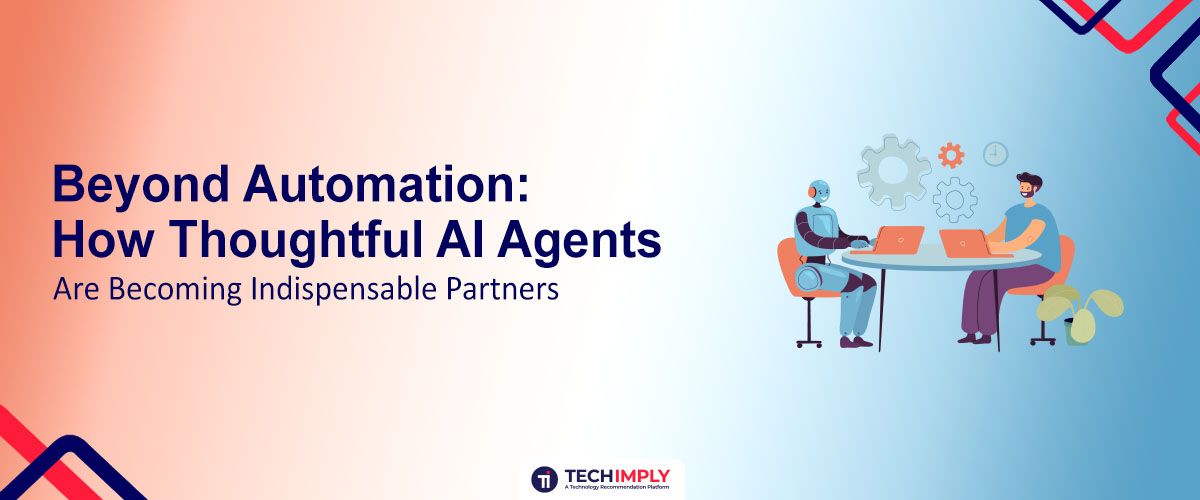
Remember the early days of "AI" in business? It often meant a rules-based chatbot on a website, frustrating us with its rigid “I didn't understand that” loops. The commitment was smart help, yet the outcome was a robotic script.
At present, a silent revolution is happening. The focus of the discussion is moving from mere automation to active partnership. The leading force behind this transformation is not a single AI with a thousand features, but a new generation of systems: smart, specific-purpose AI agent platforms—designed and deployed through a thoughtful AI agent development company that prioritize real business outcomes over novelty.
Since I am the one who facilitates the adoption of these solutions by the teams, I notice a pattern that is present in the most fruitful projects. The point is not displacing humans; rather, it is about building virtual partners who are developed to enhance our skillsets.
Let's explore what that really looks like.
The Evolution: From Tools to Teammates
Think of traditional software as a power tool. You direct every action. The AI assistant assesses the situation, gathers the necessary tools, makes the decision and performs the task, giving you either a result or a thought-provoking question.
This transformation requires a change in the entire development process and thoughts about it. This shift marks a new phase of AI Agent Business Efficiency, where intelligent systems actively enhance decision-making, automation, and operational productivity.
We’re no longer just coding "if-then" statements. We are architecting for:
-
Perception: Can the agent "see" and interpret data from multiple sources (emails, databases, live feeds)?
-
Reasoning: Can it weigh options based on context and defined goals?
-
Action: Can it safely execute tasks within digital environments (update a CRM, generate a report, route an alert)?
-
Learning: Can it adapt its performance based on feedback and outcomes?
The Blueprint of a Useful Agent: It Starts With a "Why"
The most common pitfall I see is starting with technology. The first question should never be "What cool AI can use?" It should be "What persistent, granular friction do we need to eliminate?"
A brilliant example is in customer support. A well-designed Customer Resolution Agent works silently behind the scenes instead of a chatbot trying to manage everything. A well-designed Customer support Agent works silently behind the scenes instead of a chatbot trying to manage everything.
It hears the customer's problem, immediately retrieves their whole history, examines resolved similar cases, and in a matter of seconds suggests a perfect solution to the human support agent. The human makes the ultimate decision but their role shifts from investigators to empowered decision-maker. The hassle of looking for and putting together information completely disappears.
These Agents are Outstanding in Certain High-Friction Areas:
-
The Research Synthesis Agent: For consultants and analysts, an agent that can comprehend hundreds of pages of reports, academic papers, or press articles to identify trends, contradictions, and key insights.
-
The Operational Orchestrator: In supply chains, an agent that oversees the inventory, weather, port delays, and demand signals to get ahead of the game by recommending rerouting or order adjustments
-
The Creative Springboard: For marketing teams, an agent that studies campaign performance data and audience segments to create data-driven creative briefs and content suggestions for the human team to refine. This approach works especially well when combined with marketing automation tools and chatbots, ensuring teams always receive high-quality, actionable inputs.
The Agent Isn't Always the Answer
While the potential is thrilling, strategic clarity demands we also ask: When is an AI agent overkill? Not every problem needs an autonomous teammate. In my experience, an agent is likely the wrong solution if:
-
The process changes daily. Agents excel at stable, repeatable processes. Reinventing the rules every single week means you will have to deal with reprogramming more than receiving value.
-
The data is either too messy or completely unavailable. The ability to perceive an agent is determined by the quality of the data feed given to it. "Garbage in, garbage out" turns into "garbage in, catastrophic action out." Data cleansing is the first step.
-
The accomplishment hinges on pure, unscripted creativity. The writing of a novel's first draft, the generation of a completely new product idea, the delicate negotiation of a team dispute—all these falls under the realm of human beings. An agent can act as a catalyst but not as the origin.
The place where you want to be is in the "Tedious Middle"— the intricate, multi-stage workflows that have the right balance of being important enough for codification and being active enough requiring real-time reasoning. This recognition leads to savings in terms of time, budget, and less frustration.
The Human in the Loop: The Non-Negotiable Ingredient
This is the core of humanized AI. The goal is to create machines that are smarter and more accurate not to replace humans. Having a human-in-the-loop is of utmost importance for any AI governance platform:
-
Ethical Overview: Human oversight plays a vital role in the decision-making process, especially when the AI ecosystem is subject to compliance requirements. The agent handles data, the human handles nuance.
-
Bias Mitigation: Humans train and audit agents, providing continuous feedback to catch and correct unintended biases in their reasoning.
-
The Unexpected: Agents operate within their trained domain. When a truly novel or edge-case scenario appears, the system gracefully hands off to a person.
Building this partnership requires thoughtful design. The agent's interface must build trust—clearly explaining its "thinking," citing its sources, and expressing confidence levels.
The Human-Agent Handshake
The most critical moment in any agent's workflow is the handoff point—that precise instant where it recognizes a situation requires human judgment. Designing this "handshake" is what separates a useful tool from a trusted partner.
A poor handoff feels like an interruption: a confusing alert, a dumped spreadsheet, or worse, silent inaction. A great handshake is a curated escalation. The agent should present not just a problem, but context, options, and a recommended path forward.
Think: "I've paused the campaign because the cost-per-acquisition spiked 40% outside our guardrail. Here are three potential causes ranked by likelihood, and the system impact of each. I recommend option B. Approve or modify?"
This turns oversight from a chore into a strategic review. Within an AI development company, the human is not merely correcting a mistake—they are taking care of the “why” that the AI agent does not possess. You create a genuine alliance where collective intelligence exceeds individual talent.
The Development Process: Questions to Base Your Approach On
While it is necessarily a complex process
In case you are deliberating among the various possible advantages of an AI agent for your business, let these debates pave the way for you:
-
What is our team expending most of its mental effort on?
-
Is it analyzing information, integrating information from 10 different tools, or addressing recurring but sophisticated queries?
-
Are we in possession of the necessary "fuel"? AI systems work with organized, structured, and tidy data, as well as understandable APIs, in order to successfully complete their tasks. Hence, data management is the most essential core step that needs to be taken.
-
How can "success" be defined in human terms? Is it faster onboarding for new employees? Reduced stress for our customer service team? More time for deep creative work? Measure the human impact alongside the ROI.
Your First Pilot: A 4-Quadrant Filter
You’re convinced and want to start. How do you pick the right first project? Use this simple filter to score potential ideas.
-
High-Frequency Friction: Identify if this is a task that happens dozens or hundreds of times? High volume indicates quick learning and clear ROI.
-
Clear Rules & Data: Can you, right now, write down the 5-7 main rules for deciding in this area? Do you have clean, digital records of past outcomes? If yes, you have the blueprint and the training manual.
-
Contained Impact: Can a mistake in this process be easily caught and reversed without major damage? Start where the safety net is strong.
-
Human Joy: If this task vanished from your team's plate, would they cheer? The goal is to remove drudgery. The resulting morale boost is a tangible, early win that builds internal advocacy for the project.
Plot your ideas on this grid. The task that lands on the top right of all four quadrants is your perfect pilot.
Looking Ahead: A Symphony of Specialists
The future that excites me is not a scenario where a single AI controls the whole organization. It is cooperative teamwork of agents, each of them an expert in their respective field plus that of human colleagues.
In this case, the team could consist of a design agent, a compliance agent, and a logistics agent together with a project manager working on a new product where they would be creatively, legally, and operationally managing to develop the product at the same time.
This doesn't have to be a far-off sci-fi fantasy but rather the next logical phase in our long-standing relationship with tools for human empowerment. Now it is the machine's partnership quality that gets attention and not its intelligence in isolation. The question changes from whether AI agents will be part of the workflow to how well we can design them to make the work more humane, creative, and impactful, supporting human judgment, amplifying expertise, reducing cognitive friction, and enabling people to focus on meaning, collaboration, and outcomes that truly matter. In doing so, we redefine productivity not as speed alone, but as sustained insight, ethical alignment, adaptability, and shared progress over time.

.png "How To Optimize Your Productivity By Using Machine Learning")